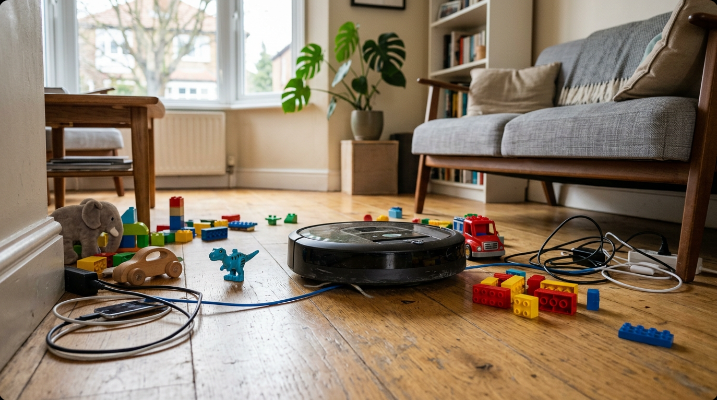
I bought a robot vacuum expecting a cleaner apartment and got, somewhat perversely, a messier one. Six months in, I finally admitted the pattern to myself: my living room floor is objectively dustier in the corners the robot can’t reach, but the bigger problem is that I’ve started leaving things on chairs, tables, and countertops that used to live on the floor, specifically to keep them out of the robot’s path. My apartment isn’t cleaner. It’s just cluttered in different, more annoying places, and it took me embarrassingly long to notice I’d made that trade.
The Honeymoon Phase
The first month was genuinely great. I ran the robot every day, the visible floor looked spotless, and I felt like I’d finally solved the low-grade guilt of not vacuuming often enough. I told friends about it with the enthusiasm of someone who’d discovered fire. What I didn’t notice yet was that I’d started making small accommodations for the robot without registering them as accommodations: moving phone chargers off the floor, keeping shoes on a rack instead of by the door, tucking cables against the baseboards. Each change felt reasonable individually. I wasn’t yet seeing the pattern.


Where the Mess Actually Went
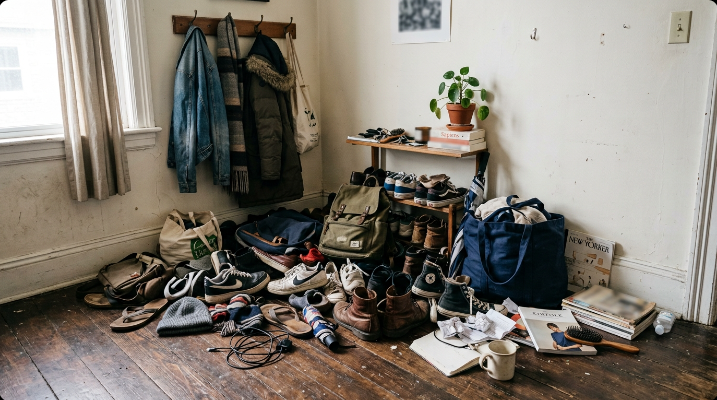
By month three the pattern was undeniable once I looked for it. My dining table, which used to be clear, had become a landing zone for mail, keys, and whatever I was carrying when I walked in the door, specifically because those things used to just get dropped near the entryway and vacuumed around, and now they needed a surface the robot couldn’t reach. My couch armrests accumulated books and remotes that used to sit on the floor beside it. I hadn’t consciously decided to become a person who piles things on furniture. I’d just optimized, without noticing, for keeping the robot’s path clear, and flat surfaces absorbed everything the floor used to hold.
The Specific Mechanism I Didn’t Expect
What surprised me most was realizing this wasn’t really about laziness or disorganization getting worse. It was a rational response to a new constraint I hadn’t consciously adopted. The robot vacuum works best, and avoids getting stuck, when the floor is clear of small objects, cords, and low-hanging fabric. I’d internalized “keep the floor clear for the robot” as an actual behavioral rule within about six weeks, without ever articulating it to myself, and the natural consequence of that rule was that everything I used to leave on the floor migrated upward to whatever surface was nearest. The robot didn’t reduce my clutter. It relocated it to places that are more visible and, honestly, more annoying to deal with than an out-of-the-way floor corner ever was.
What the Data on Automation and Habits Suggests
This tracks with a broader pattern researchers have documented around household automation: labor-saving devices often change behavior in ways that don’t straightforwardly reduce total effort or mess, they redistribute it. Time-use studies on domestic technology going back to washing machines and dishwashers have repeatedly found that automation of one task frequently shifts standards upward or shifts the remaining burden elsewhere, rather than simply freeing up the time saved. Robot vacuum-specific consumer research and reviews have noted the same “furniture becomes storage” complaint often enough that some newer models are explicitly marketed around better under-furniture navigation and cord detection, which is itself a tacit admission that this is a common, predictable side effect rather than a personal failing.
A Real Comparison: My Bedroom Versus My Living Room
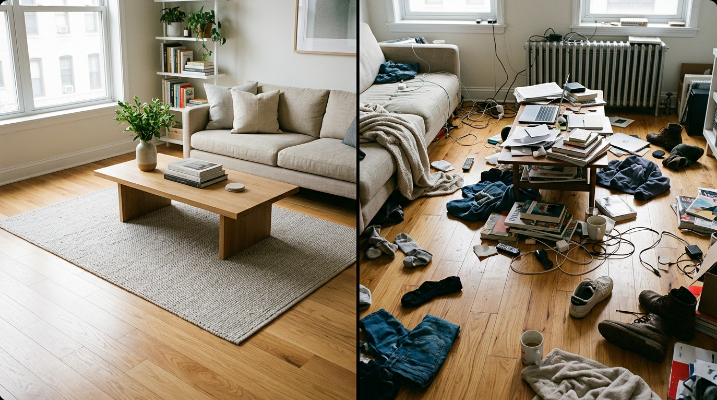
The clearest evidence came from comparing two rooms in my own apartment. My bedroom, where I never run the robot because the door stays closed for the cat, still has the old pattern: shoes by the bed, a book on the floor next to where I’m reading it, nothing particularly tidy but also nothing weirdly piled on surfaces. My living room, robot-optimized, has almost nothing on the floor and noticeably more on every horizontal surface than it did a year ago. Same person, same general tidiness habits, two different outcomes based entirely on which room has a robot changing my unconscious rules about where things go.
Where the Robot Genuinely Helps
I don’t want to overstate the downside here, because the actual floor is cleaner in a way that matters. Dust and pet hair accumulation, the stuff that’s genuinely bad to breathe and annoying to deal with by hand, really is better controlled now, and that’s not a small thing. The problem isn’t that the robot fails at its one job. It’s that optimizing my apartment around that one job created a second, unplanned job of surface management that nobody was tracking, including me, until the mess became visually obvious enough to notice.
What I Changed Once I Noticed
I didn’t get rid of the robot, but I did make one deliberate change: a five-minute end-of-day reset where I specifically clear surfaces back onto the floor for the next robot run, or into actual storage, rather than letting them accumulate. This sounds like it defeats the purpose, and in a narrow sense it does add back a small task, but it’s a much shorter task than the general apartment tidying I used to skip entirely, and it directly counters the migration pattern instead of pretending it doesn’t exist. The robot still does the actual floor cleaning. I just stopped assuming it was managing my clutter problem for free.
The Cord I Kept Tripping Over
The clearest example of the mechanism showed up with a phone charging cable in my living room. Before the robot, I’d leave it draped loosely across the side table, in easy reach, because I plugged in there every evening. Once the vacuum started running its daily route, that cable became a hazard the robot would either drag across the floor or get tangled in and stop, triggering an error notification on my phone. So I started tucking it away completely between uses, coiled and stashed in a drawer, purely to keep the robot happy.
That solved the robot’s problem and created a small one of my own. Now, every evening, I have an extra step: dig the cable back out of the drawer, use it, then put it away again before the vacuum’s next scheduled run. What used to be a zero-effort loose cable sitting in plain reach became a two-step ritual, morning and night, that exists purely to accommodate a machine whose entire selling point was supposed to be reducing effort. Multiply that by the six or seven similar items I’ve relocated for the robot’s sake, shoe trays, a yoga mat, a stack of magazines, and I’m doing measurably more small tidying tasks than I was before I owned it.
Why “Robot-Proofing” Became a Second Chore
I eventually gave this pattern a name, because I kept doing it without meaning to: robot-proofing. Every object on my floor got silently re-evaluated not by whether it belonged there for my convenience, but by whether it would survive an encounter with a machine that runs on autopilot at two in the afternoon while I’m at work. Cables, low baskets, anything with tassels or fringe, small toys, all of it moved either permanently upward onto shelves and tables or into closed containers.
On paper this sounds like a good thing, a forcing function toward tidiness I probably needed anyway. In practice it didn’t feel like tidiness. It felt like maintenance, the same way keeping a car running requires periodic attention regardless of whether you actually enjoy driving it. I hadn’t decided my house needed less stuff on the floor. I’d been recruited, gradually and without a formal decision, into keeping it that way so a five-hundred-dollar appliance could complete its route without getting stuck.
The distinction matters because it changes how I think about what the robot actually saved me. It didn’t eliminate the work of managing floor clutter. It relocated that work from an occasional, low-stakes tidy-up to a constant, low-grade vigilance, checking every new object I bring into a room against whether the robot will handle it gracefully. That’s a real cost, even if it doesn’t show up on the box.
The Trade-Off I’ve Made Peace With
None of this means I regret buying it. The floors themselves are genuinely cleaner than they were when vacuuming was a once-a-week chore I sometimes skipped for two weeks running. What changed is that I stopped believing the marketing promise of effortless cleanliness and started being honest with myself about what kind of effort I’d actually traded for what kind. I traded an occasional, concentrated chore for a smaller, constant one spread across every single day. For me, that trade has been worth it. But it is a trade, not a subtraction, and I wish more of the marketing around these devices was honest about that instead of selling pure convenience with no asterisk attached.
If I were advising a friend considering the same purchase, I’d tell them to budget for that hidden maintenance loop honestly before buying, not after. Ask what the floor actually looks like on a normal, busy weekday, not a tidy showroom day, and picture doing that relocation dance every single morning before you leave the house. For some households that trade is an easy yes. For others, especially anyone already stretched thin on daily bandwidth, it might be one more small obligation dressed up as a convenience.
I’ve settled on a modest compromise: I let two rooms, the bedroom and the office, stay off the robot’s schedule entirely, vacuuming them by hand every couple of weeks. That keeps the robot-proofing obligation contained to the rooms where the daily run actually matters most, instead of spreading the same low-grade vigilance across the entire house.
What This Taught Me About Automating Habits
The real lesson wasn’t about vacuums specifically. It was that automating one visible piece of a routine can quietly restructure the whole routine around the automation’s constraints, in ways that don’t show up until you go looking for them. My apartment isn’t messier because the robot failed. It’s messier because I adapted to the robot in a way that solved its problem while creating a new one of my own, and I only caught it because the surfaces got cluttered enough to finally catch my eye instead of my attention.
