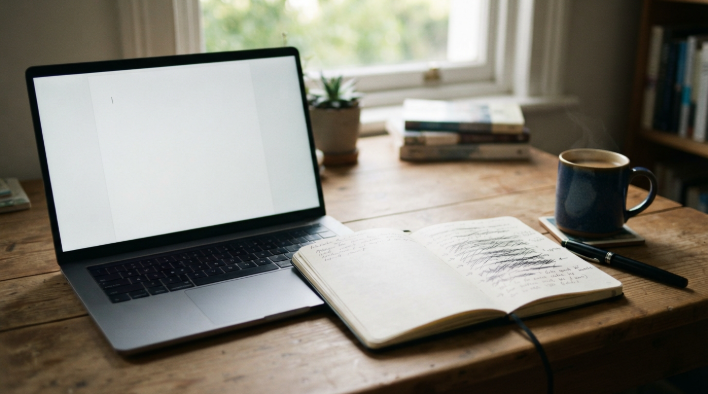
A few months ago, I opened a blank document to write an email that mattered. It was a message to an old friend I had fallen out of touch with, and I wanted to apologize for disappearing. Out of pure habit, before I had typed a single word, my hand moved toward the AI writing assistant. I stopped halfway. It occurred to me that I did not actually know what I wanted to say yet, and I was about to ask a machine to tell me.
That small moment made me look more honestly at how I had been writing for the past year or so. Almost everything I wrote, from work reports to birthday messages, started with an AI-generated draft that I then edited. It was fast and it was usually fine. But I began to suspect it was also changing something about how I think. So I tried an experiment: for two months, I wrote every first draft myself, and only used AI, if at all, after I had something of my own on the page. Here is what happened.
How the AI-first habit crept in
I never made a conscious decision to let AI write my first drafts. It happened gradually. At first, I used it for tedious things: rewording a formal request, summarizing a long document, drafting a polite reply to a vendor. It was genuinely helpful, and I saved real time.
Then the boundary moved. I started using it for things that were not tedious at all, just slightly uncomfortable. A difficult message to a colleague. A short speech for a friend’s birthday. A blog post outline. The blank page is uncomfortable for almost everyone, and the AI made that discomfort disappear. Instead of staring at nothing, I was always staring at something, and editing something is always easier than creating something.
The trouble is that the discomfort of the blank page is not just an obstacle. It is often where the thinking happens. When you have to figure out your first sentence, you are forced to figure out what you actually believe. When a machine hands you a first sentence, you skip that step and jump straight to judging whether its sentence is acceptable. Those are very different mental activities.
The first week without it was harder than I expected
I will be honest: the first few days were uncomfortable. Writing a simple work update took me noticeably longer. I wrote clumsy sentences, deleted them, and wrote them again. At one point I spent ten minutes on a single paragraph for a project summary that the AI would have produced in five seconds.
I also noticed how much I had come to rely on the AI’s structure. Its drafts always came in a tidy shape: an introduction, three neat points, a conclusion. Without that scaffold, my writing wandered. My first drafts were messier, with ideas in the wrong order and some sections far longer than others. It was humbling to see how much of the apparent organization in my recent writing had not come from me.
But something else happened in that first week too. When I went back to reread what I had written, it sounded like me. Not a polished, generic version of a professional person, but specifically me, with my slightly odd phrasing and my habit of using too many examples. I had not realized how much I had missed that until I heard it again.
My thinking got clearer, not just my writing
By the second week, the slowness started to pay off in unexpected ways. Writing my own first drafts forced me to answer questions I had been quietly avoiding. In a project proposal, I got stuck on one section because I could not explain why one option was better than another. With AI, I would have received a confident paragraph making the case, and I would have accepted it. Writing it myself, I realized I did not actually have a good reason, and that the other option might be better. That changed the proposal completely.
There is an old idea that writing is thinking made visible, and I understand it better now. When the AI wrote first, it was doing some of the thinking for me, and I was only checking its work. That is fine for a thank-you note. It is risky for anything where the quality of the reasoning actually matters. A persuasive, well-written paragraph can hide a weak idea very effectively, and the better AI becomes at writing, the better it becomes at hiding weak ideas.
I also noticed my opinions became more specific. AI drafts tend toward balance and safe middle ground, which is useful in some contexts and bland in most others. When I wrote first, I took positions. I said what I actually thought. Some of those positions were wrong, and editing fixed them, but at least there was a real position to edit.


The emotional messages mattered most
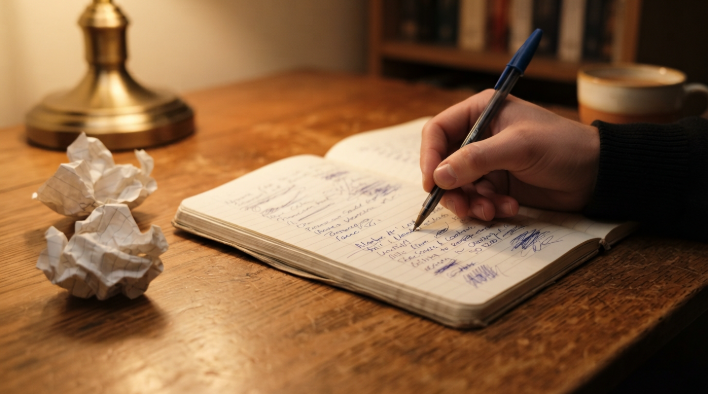
That email to my old friend ended up being the most important thing I wrote during the experiment. It took me three evenings. The first version was far too long and too defensive. The second was too short and too casual. The third was imperfect but honest, and it included a detail about a trip we had taken years ago that no machine could have known to mention.
My friend replied within an hour and we had a long phone call that weekend. I cannot prove it, of course, but I do not believe a smooth, AI-assisted apology would have landed the same way. People can often sense when words have been assembled rather than felt. There is a certain texture to writing that comes from someone struggling to say something true, and polish tends to sand that texture away.
This made me reconsider all the small personal messages I had outsourced: birthday cards, condolence notes, congratulations. They were grammatically better when the AI helped. But they were also more generic, and the whole point of those messages is that they are not generic. A slightly awkward sentence written by a friend is worth more than a perfect sentence written by nobody.
Where AI still earns its place in my process
I did not come out of this experiment with a strict anti-AI rule, and I think that would be a mistake. What changed was the order of operations. Now I write first, and then I use AI as an editor, a critic, or a sparring partner, depending on what I need.
Some of the most useful things I ask it now are questions about my own draft. What is the weakest argument here? Where would a skeptical reader push back? Is there a section that is confusing? This kind of feedback is often excellent, and because the draft is mine, the ideas stay mine. The AI helps me sharpen my thinking rather than replace it.
I still use AI freely for writing that is purely functional. Formatting a document, rephrasing a dense technical paragraph for a general audience, drafting a standard out-of-office message, or turning bullet notes into a short summary. Nobody needs my personal voice in a meeting reminder. The line I draw now is simple: if the writing is meant to carry my thinking or my feelings, the first draft is mine.
What I noticed in other people’s writing
Once I started paying attention, I began to notice AI-first writing everywhere. Emails from colleagues that were perfectly structured and slightly empty. Social media posts with the same rhythm and the same kinds of phrases. Product descriptions that all seemed to share a vocabulary. None of it was bad, exactly. It was just interchangeable.
That made me think about what happens at scale. If most of us start from the same kind of draft, produced by similar systems trained on similar data, our writing will slowly drift toward the same middle. The quirks and personal habits that make writing recognizable might fade. For individuals, that is a small loss. For a culture, it might be a bigger one. Some of the most memorable writing in history came from people who wrote in ways nobody else would have.
I do not want to exaggerate this. People have always used templates, and formal writing has always been somewhat uniform. But there is a difference between using a template for a business letter and using a machine to generate your first thoughts on almost everything. The second one touches how we think, not just how we format.
Tips if you want to try this yourself
If you are curious about reclaiming your first drafts, a few things helped me more than willpower. First, I lowered my standard for the first draft to almost nothing. It is allowed to be bad. Its only job is to exist. Once I gave myself permission to write a terrible first version, the blank page became far less intimidating.
Second, I started with talking rather than typing when I felt stuck. I would explain the idea out loud to myself, or record a quick voice memo, and then write down what I had said. Most of us are clearer when speaking casually than when trying to write formally, and this gets past the frozen first sentence.
Third, I set a simple rule: no AI until there is at least one full paragraph of my own on the page. Sometimes I did not need AI at all after that. When I did, I was using it to improve something real rather than to invent something from scratch.
Slower, but more mine
Two months later, I write more slowly than I did at the height of my AI habit. That is simply true. But I also write things I am prouder of, and more importantly, I understand my own ideas better before I share them. The time I lost in drafting, I have often gained back by not having to fix decisions based on arguments I never really thought through.
The blank page is still uncomfortable. I have made peace with that. I think a little discomfort is the price of having something of your own to say, and it turns out that is a price I am happy to pay. The machine can help me say it better. It just should not be the one deciding what I say.
