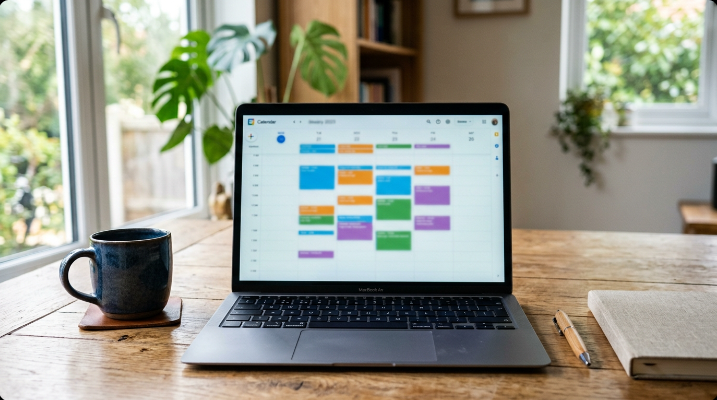
I let an AI assistant plan my work week for a full month, treating its schedule as close to gospel unless something was genuinely broken, and the biggest change wasn’t productivity in the way I expected. It was that I stopped starting every Monday by staring at a blank list wondering what actually mattered. That specific low-grade friction, the ten minutes of morning indecision I’d done for years without noticing it as a cost, turned out to be the thing worth measuring, more than any output metric I tracked.
How I Actually Set This Up
Each Sunday I fed the assistant my task list, deadlines, and a rough priority note, and let it produce a day-by-day schedule with blocked time for deep work, meetings, and admin tasks. I gave myself one rule: follow the plan as written for at least the first half of the day before deciding to deviate, rather than second-guessing it before I’d even started. That rule mattered more than the scheduling itself, because my old habit was re-planning my day three or four times before 10 a.m., and the AI plan gave me a fixed reference point to actually compare against instead of constantly renegotiating with myself.


The First Week Was Genuinely Uncomfortable
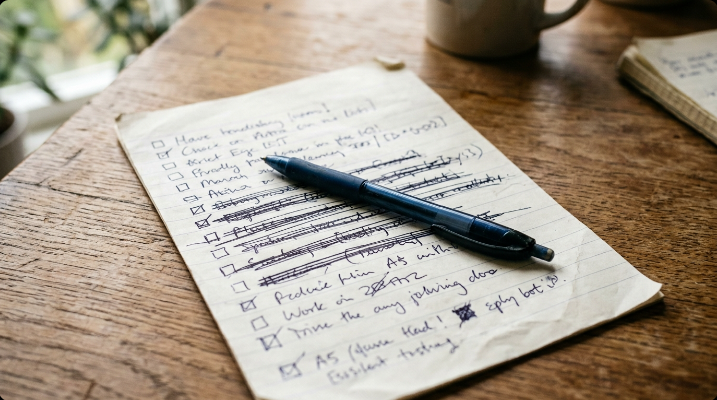
I didn’t expect the discomfort to be about trust in the AI’s judgment. It was about noticing how much of my usual “planning” was actually a form of procrastination dressed up as productivity, moving tasks around, reordering priorities, tweaking a list, none of which was the actual work. Without that fidgeting available to me, because the schedule was already set, I had noticeably more raw time in front of me each morning, and some of that time initially just felt exposed rather than productive.
What Changed by Week Three
The clearest shift was in how many decisions I was making per day. Before, I was making dozens of small sequencing decisions constantly throughout the day, what to do next, whether to switch tasks, whether something suddenly felt more urgent. With a pre-built schedule I was mostly executing rather than deciding, and by week three I noticed I had more mental energy left by late afternoon than I remembered having in months, not because the work itself was easier, but because I’d removed a layer of continuous, low-grade decision-making that I hadn’t previously counted as effort at all.

A Specific Comparison: Two Similar Deadline Weeks
I got a fairly clean comparison when two similarly demanding project weeks landed a few weeks apart, one before I started this experiment and one during it. In the first, self-planned week, I missed one internal deadline by a day and worked two unplanned late evenings to catch up, largely because I’d underestimated how long earlier tasks would take and hadn’t left buffer. In the AI-planned week, the schedule had built in buffer blocks I wouldn’t have thought to add myself, and I hit every deadline without a single late evening. That difference wasn’t about the AI being smarter than me about my own work. It was better at the specific, tedious task of realistic time buffering, which I habitually skipped.
Where the AI’s Plan Was Actually Wrong
I don’t want to overstate this as flawless. The assistant consistently underestimated how long tasks requiring back-and-forth with colleagues would take, since it had no visibility into other people’s response times, and it occasionally scheduled deep-focus blocks right after meetings that reliably left me too scattered to use them well. I ended up manually adjusting roughly one block per day on average, which is a meaningful correction rate, not a rounding error, and worth being honest about rather than presenting this as a perfect system.
What Behavioral Research on Decision Fatigue Suggests
This pattern lines up with a well-established finding in behavioral research: the quality of a person’s decisions tends to degrade over the course of a day as the cumulative number of decisions made increases, a pattern often called decision fatigue. Researchers studying this effect have found it applies not just to major choices but to the accumulation of small, routine ones, which matches what I noticed, the constant re-sequencing of my own day was itself a decision-making cost, even though each individual choice felt trivial in isolation. Offloading that specific category of small planning decisions, while keeping the actual work decisions for myself, appears to be where the benefit concentrated.
What I Deliberately Did Not Hand Over
I kept every substantive judgment call for myself: what counted as a priority, which projects mattered most, how to handle a colleague conflict that came up mid-month. The AI only ever touched sequencing and time allocation, never the actual content or stakes of decisions. That boundary felt important to maintain deliberately, not because I distrusted the tool broadly, but because collapsing “what should I do” and “when should I do it” into the same automated process seemed like a different and much bigger decision than the one I’d actually signed up to test.
How I’ve Settled Into Using It Now
A month in, I still use AI scheduling for the routine week-to-week sequencing, but I’ve dropped the rule about following it blindly for half the day. Instead I glance at the plan each morning, adjust the one or two blocks that predictably need it based on what I’ve learned about its blind spots, and then treat the rest as fixed. This isn’t dramatically different from how I’d want to work with a good human assistant handling my calendar, honestly, and framing it that way helped me calibrate how much authority to actually give it.
The Day It Scheduled My Dentist Appointment Over a Client Call
The clearest failure came in week two, when the planner double-booked a recurring client call against a dentist appointment I’d entered as a fixed, non-negotiable event. On paper the system should have caught this easily; the appointment was marked immovable in the settings I’d configured myself. Instead it generated a plan that quietly shrank the appointment’s buffer time to zero and scheduled a prep task for the client call directly on top of the drive time I’d need to get to the dentist’s office across town.
I only caught it because I happened to glance at the full week view Sunday night instead of just following the day-by-day prompts, which had become my default habit by that point. Had I trusted the daily prompts blindly, I would have either missed the appointment or shown up late and frazzled to the client call, having skipped a chunk of prep time I actually needed. When I flagged the conflict, the tool apologized in that smooth, characterless way these systems do and rebuilt the day correctly in about ten seconds, which was almost more unsettling than the original mistake. It could fix the problem instantly once shown it, but it hadn’t caught something a five-second glance at a calendar would have caught for a human assistant.
That incident became the reason I never fully stopped doing my own Sunday-night review, even in the months after the experiment when I kept using the tool. The plan is good enough to trust for the shape of a week. It is not yet good enough to trust unsupervised for the specific collisions that actually matter.
What I Learned About My Own Time Estimates Being Wrong
The more interesting discovery wasn’t about the AI at all. It was about how consistently wrong my own time estimates had been for years before I ever handed the job over. The tool asks you to log actual time spent against each planned task, and after about three weeks of that data, a pattern became impossible to ignore: I estimated almost every writing task at roughly sixty percent of the time it actually took, and almost every administrative task, emails, invoicing, scheduling, at nearly double the time it actually required.
I had been unconsciously compensating for this miscalibration for years by overbooking my days and then feeling perpetually behind, without ever identifying the actual source of the feeling. Seeing the gap laid out numerically, task by task, over real weeks was more clarifying than any planning system’s suggestions. The AI’s actual scheduling advice was often just adequate. The side effect of forcing me to track estimate versus actual time, which I’d never done consistently before, turned out to be the genuinely valuable part of the whole month-long experiment, and it’s the one habit I kept doing manually even after I stopped using the tool for the scheduling itself.
The Colleague Who Tried the Same Thing and Quit After a Week
A coworker started the same experiment around the same time I did, using a different AI planning tool, and abandoned it after six days. Comparing notes afterward was useful, because our failure points were different in a way that says something about how individual these systems actually are. Her main complaint wasn’t accuracy, it was that the plan felt prescriptive rather than collaborative, a set of instructions handed down rather than a draft she could push back on. She wanted to negotiate with her schedule the way she would with a human assistant, and the interface made that feel clunky and slow, so she went back to a blank calendar and her own judgment.
I think the difference in our outcomes came down to how each of us used the daily check-in feature. I treated every proposed plan as a draft I was expected to edit, moving at least one thing most days. She treated the first version as close to final and felt controlled by it when it turned out to be wrong. Neither reaction is unreasonable. It suggests these tools work best for people who are comfortable overriding a machine’s suggestion without feeling like they’ve failed at using it correctly, and less well for people who want a tool that already knows them well enough not to need correcting.
What This Month Actually Taught Me
The real change wasn’t that I got more done, though I did, modestly. It was that I discovered a category of daily effort, constant re-planning and re-sequencing, that I’d never counted as work at all, and removing it freed up more attention than I expected. The AI wasn’t making better decisions than me about what mattered. It was just handling the tedious logistics I’d been quietly, inefficiently doing myself the entire time, without ever noticing I was doing it.
