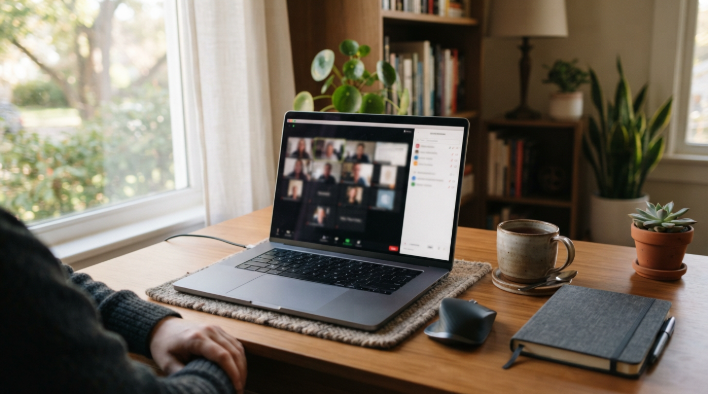
The first time I noticed it, I was reading the AI-generated summary of a meeting I had actually attended. It was accurate. Every decision was listed, every action item had an owner, and the whole thing fit neatly on one screen. And yet, reading it, I had the strange feeling that it described a different meeting from the one I remembered. The facts were right. The meeting was missing.
For about a month, I let an AI note-taker sit in on almost every call I had: team check-ins, client calls, a couple of one-on-ones, even a long planning session that ran well over its time. I wanted to know whether automatic summaries would actually save me time, or whether they would just move the work somewhere else. What I found was more interesting than a simple yes or no, and it changed how I think about what a meeting is even for.
The first week felt like a small miracle
I will not pretend the start was anything other than impressive. I stopped typing during calls. I stopped half-listening while scribbling down a date someone mentioned. For the first time in years, I looked at people on video while they talked instead of at my own notes document. That alone felt like a gift.
After each call, a tidy summary landed in my inbox within a few minutes. It had a short overview, a bulleted list of decisions, and a list of next steps with names attached. When a colleague asked me on Thursday what we had agreed about a deadline on Monday, I searched the summaries and found it in seconds. I felt organized in a way I usually only pretend to be.
I also noticed that I was more present in conversations. When you are not responsible for capturing everything, you have more attention left over for actually thinking. I asked better follow-up questions. I noticed when someone went quiet. For a week or so, I was convinced this was the best productivity change I had made all year.
Then I started noticing what was not there
The cracks showed up in the second week, and they were subtle. In one planning call, a teammate agreed to take on a new piece of work. The summary recorded it faithfully: she would own the rollout and report back in two weeks. What it did not record was the long pause before she said yes, or the slightly flat way she said it. Anyone who was on the call knew she was stretched thin and had agreed out of obligation. The summary made it look like enthusiasm.
That pattern repeated. Summaries capture what was said, not how it was said. They capture conclusions, not hesitations. A decision that was reached after twenty minutes of real disagreement looks exactly the same on paper as one that everyone agreed to in thirty seconds. When I went back to those summaries a week later, I could no longer tell which decisions were solid and which were fragile.
There was also a quieter loss. Meetings are full of small side comments, jokes, and half-formed ideas that nobody acts on right away. An offhand remark about a customer complaint, a passing mention of a tool someone had tried. These are exactly the things a summary trims away as noise, and they are often exactly the things that turn out to matter a month later. My own notes used to be messy, but they were messy in useful ways. They held the stray thoughts that caught my attention.
My memory got lazier, and I could feel it
This was the part that surprised me most. By the third week, I noticed I was remembering less from meetings than I used to. Not dramatically less, but enough to notice. Someone would reference a conversation and I would have only a vague sense of it until I pulled up the summary.
When I thought about it, it made sense. Taking notes, even bad notes, forces you to decide what matters. That act of choosing is part of how things stick. When the machine does the choosing, you get the output without the processing. It is a bit like the difference between walking a route yourself and being driven along it. You arrive at the same place, but only one of those leaves you knowing the way.
Researchers have talked for a long time about something called cognitive offloading, which is the idea that when we know information is stored somewhere reliable, we put less effort into remembering it ourselves. That is not necessarily bad. We all offload phone numbers to our contacts and appointments to our calendars. But meetings are not phone numbers. They are where a team builds a shared understanding, and I am not sure that understanding can be fully offloaded.



The summaries started shaping the meetings
Something else happened that I did not expect. Once everyone knew there would be an automatic summary, the meetings themselves started to change. People began speaking in a slightly more formal way, especially near the end of calls, as if dictating to the record. A few colleagues started stating decisions explicitly and slowly, clearly hoping the AI would pick them up correctly.
On one hand, that is useful. Clear decisions are good. On the other hand, a few people seemed to become more careful about what they said out loud. One colleague told me privately that she no longer floated half-baked ideas on recorded calls, because she did not want an early, rough thought turning into a permanent bullet point with her name next to it. That is a real cost. The best ideas often start out as bad ideas that someone was brave enough to say.
I also had to deal with the awkward question of consent. Not everyone likes being recorded and transcribed, and it is easy to forget that when the tool runs by default. A couple of external guests were clearly uncomfortable when they saw the note-taker in the participant list. I started asking at the beginning of calls, and a few times I switched it off. That felt like the right thing to do, and it also reminded me that convenience for me is not always comfort for everyone else.
Where the tool genuinely earned its place
I do not want this to sound like a story where the technology was a mistake. It was not. Some meetings benefit enormously from automatic summaries. Status updates, where the whole point is to exchange facts quickly, were perfect for it. So were long calls with lots of dates, numbers, and names, where my handwritten notes would have been full of gaps anyway.
The transcripts were also valuable in a different way than the summaries. When someone disagreed about what had been said, the transcript settled it without drama. When I missed part of a call because of a bad connection, I could read the exact words instead of relying on someone else’s recollection. And for people who join a project halfway through, being able to skim the last few weeks of meeting summaries is a real advantage.
So the lesson was not that AI summaries are bad. It was that they are good at one specific job, which is recording outcomes, and they are not good at the other jobs a meeting does, like building trust, sensing doubt, and letting half-formed ideas breathe.

What the summary cannot tell a newcomer
Near the end of the month, a new person joined our team, and I suggested she read through a few weeks of meeting summaries to get up to speed. It seemed efficient. A few days later, she told me the summaries were helpful but also a little misleading. She had come away thinking the team was aligned on everything, because every summary presented tidy decisions. It took several real conversations for her to understand which topics were still sore spots and which people had strong opinions they had not fully expressed.
That conversation stayed with me. Written records have always flattened things, of course. Traditional meeting minutes were never full of emotional nuance either. But there is something about the polish of an AI summary that makes it feel more complete than it is. It reads as the whole story, so people treat it as the whole story. Handwritten notes, with their scribbles and question marks, at least looked unfinished.
What I changed after the experiment
I have not turned the note-taker off completely. Instead, I use it more deliberately. For routine status calls and anything heavy on logistics, it stays on, and I trust the summary. For conversations where the tone matters, like one-on-ones, early brainstorming sessions, or anything involving difficult feedback, I leave it off and take my own notes, even if they are messy.
I also started adding a short line of my own to the AI summaries of important meetings. Just one or two sentences about how the conversation felt. Things like “agreed, but with real concern about the timeline” or “strong support from everyone, this one feels solid.” It takes less than a minute, and it restores some of what the summary strips out. When I read those summaries weeks later, that one human line is often the most useful part.
Finally, I try to write down one thing from each important meeting from memory before I look at the summary. It is a small habit, but it forces me to process the conversation myself instead of outsourcing that step completely. My recall has improved noticeably since I started doing it.
A meeting is more than its minutes
The biggest thing this month taught me is that we have been measuring meetings by the wrong output. If a meeting only existed to produce a list of decisions and tasks, most of them could be replaced by a short document. The reason we still get together, on video or in person, is that meetings also do invisible work. They let us read each other, test ideas, notice tension, and slowly build the kind of trust that makes the decisions stick.
AI note-takers are very good at capturing the visible part. They are not built to capture the invisible part, and perhaps they never will be. That is fine, as long as we remember the difference. The danger is not that the summaries are wrong. It is that they are right enough that we stop paying attention to everything they leave out.
So I still let the machine take notes. I just no longer let it take all of them.
