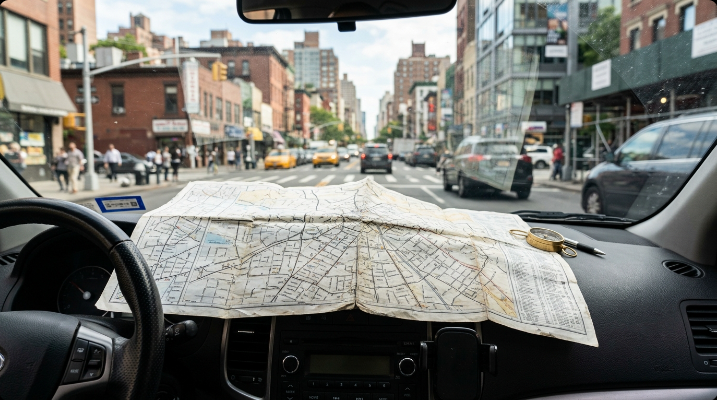
I got genuinely lost three blocks from my own apartment on day two, and that’s when I realized how much I’d outsourced my sense of the city I’ve lived in for six years. I’d turned off Google Maps for a personal experiment, just walking and driving by memory and street signs for a week, expecting mild inconvenience. Instead I found myself standing at an intersection I must have driven through hundreds of times, with zero idea which direction led home, phone in my pocket deliberately unopened, feeling a specific kind of disorientation I hadn’t experienced since I first moved here.
Why I Tried This in the First Place
The prompt was embarrassingly small: my sister visited from out of town and asked me for directions to a coffee shop four blocks from my apartment, and I genuinely couldn’t tell her without pulling up the app. Not the name of the street, not which way to turn, nothing. I’d walked past that coffee shop probably two hundred times. That moment bothered me enough that I decided to spend a week relying on memory, landmarks, and paper-map-era navigation skills I assumed I still had somewhere underneath years of turn-by-turn voice directions.
The First Two Days Were Genuinely Disorienting
I’d assumed six years in one city would have built a mental map I could fall back on. What I actually had was a collection of disconnected point-to-point routes: I knew exactly how to get from my apartment to work, from work to my gym, from my apartment to two or three regular restaurants, but almost nothing about how those routes related to each other spatially. I could not have told you, without a map, whether my gym was north or south of my office, even though I’d driven between them dozens of times. Turn-by-turn navigation had taught me sequences of turns, not an actual mental model of the city’s layout.

What Changed by Day Four
The disorientation didn’t last the whole week. By day four, something shifted: I started noticing landmarks I’d apparently walked past for years without registering, a particular building’s odd roofline, a consistent slope in a street that told me which way was downhill toward the river. I began building actual spatial relationships between places instead of memorized turn sequences. Getting mildly lost twice in the first two days seemed to be a necessary part of this; the disorientation forced my brain to start paying attention to the environment instead of a screen.
The Research Behind What I Was Feeling
This tracks with research on GPS use and spatial memory that’s been building for over a decade now. Several studies using brain imaging have found that people who rely heavily on turn-by-turn navigation show reduced activity in the hippocampus, the brain region most associated with spatial memory and cognitive mapping, compared to people who navigate using landmarks and self-generated routes. Researchers studying London taxi drivers, famous for their detailed mental maps of the city, found measurably larger hippocampal volume compared to non-drivers, and follow-up work has suggested that outsourcing navigation to GPS may prevent this kind of spatial memory development from happening at all, rather than just failing to use skills you already have.
A Real Comparison: Two Trips to the Same Store
Midway through the week I needed to get to a hardware store I’d only visited once before, using GPS, months earlier. Under the old system, I would have just opened the app and followed the voice. Instead I had to actually think: I remembered it was near a park, roughly fifteen minutes by car, past a distinctive church. I got there in eighteen minutes with one wrong turn I self-corrected. Three days later I needed to return for a forgotten item, and this time I drove there in twelve minutes without a single wrong turn, because the first trip had actually built a route in my memory rather than just executing one. With GPS, my two trips to that same store would likely have taken the identical eleven minutes each time, with zero improvement, because I never would have needed to encode the route myself.
Where I Genuinely Missed the App
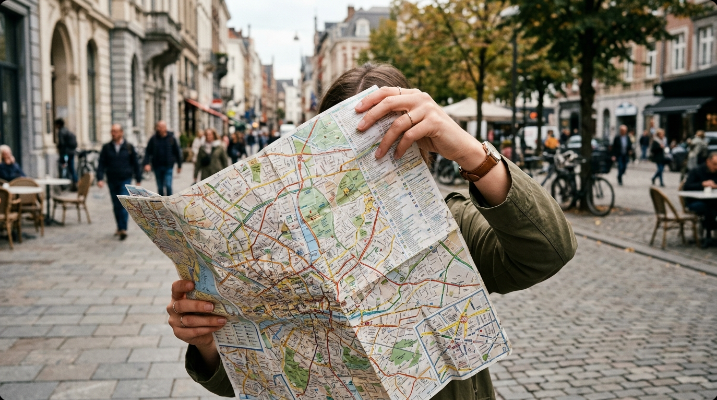
I want to be honest that this wasn’t purely a triumphant rediscovery of ancient human skills. Real-time traffic rerouting is a genuine, significant advantage that landmark navigation cannot replicate, and I sat in fifteen extra minutes of avoidable traffic twice that week because I had no way of knowing about an accident two streets ahead. Finding specific addresses in unfamiliar neighborhoods, especially at night, was also meaningfully harder and occasionally a little unsafe-feeling in ways I don’t think are worth romanticizing. I’m not arguing GPS is bad technology. I’m arguing that constant reliance on it seems to have a real cognitive cost that the convenience obscures.
What I Changed After the Week Ended
I didn’t delete Google Maps, and I don’t think anyone reasonably should. What I changed was smaller and, I think, sustainable: for any route inside my own city that I expect to drive more than twice, I now glance at the map once beforehand to understand the general direction and key streets, then navigate the actual drive without voice turn-by-turn unless something goes wrong. For unfamiliar areas, especially outside my city, I still use full navigation without hesitation. The distinction that matters to me now is between places I live my life in, which deserve an actual mental map, and places I’m passing through, which don’t.
The One Time I Actually Got Lost
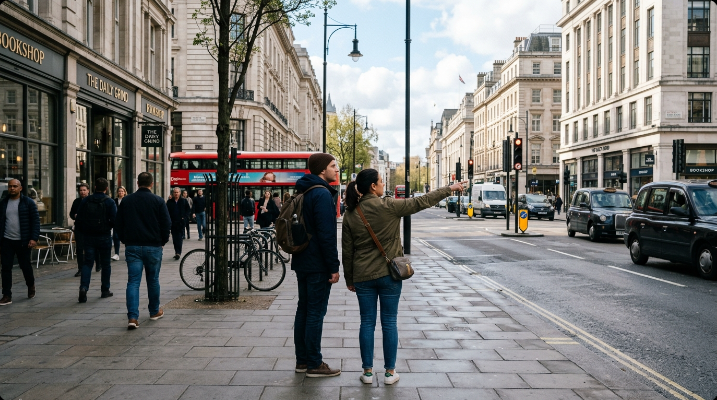
There was exactly one moment during the week when the experiment stopped being charming and started being genuinely stressful. On day five I drove to a part of town I don’t visit often, for a dentist appointment I couldn’t afford to be late for, and I misjudged a turn based on a mental map that turned out to be about a decade out of date. A road I remembered as a straight shot had been rerouted around a new development, and I ended up circling the same three blocks for almost fifteen minutes with the clock ticking down before I finally pulled over, embarrassed, and just asked a man walking his dog for directions.
He knew immediately, pointed me the right way, and I made it with two minutes to spare. But the fifteen minutes before that were a genuinely different kind of stress than the mild, curious disorientation I’d felt on day one. This wasn’t dawdling around discovering a coffee shop. This was time-pressured, consequence-attached navigation, the exact situation Google Maps is best at solving, and the exact situation where I felt its absence most sharply. It was a useful reminder that the case for occasionally going without the app isn’t the same as a case for abandoning it. There’s a real difference between wandering without a destination and needing to be somewhere specific by a specific time.
That incident also clarified something about my own overconfidence. I’d assumed, going in, that I basically knew my own city and the app was mostly redundant for local trips. The wrong turn proved that assumption wrong in about four minutes. My mental map hadn’t been updated in years, and I hadn’t noticed because I’d never had a reason to test it against reality. The app wasn’t just replacing my navigation ability. In some quiet way, it had also been letting my actual knowledge of the city go stale without my noticing.
What My Brain Was Doing Instead of the App
By the middle of the week, I noticed I’d started narrating my own routes out loud without meaning to, something like “okay, past the pharmacy, then left at the church, then it’s the third light.” That habit, building a verbal chain of landmarks instead of following a blue dot, is apparently a well-documented way people navigated for most of human history before turn-by-turn directions existed, and it felt almost like relearning a skill my brain still had the hardware for but hadn’t exercised in years.
The landmark method turned out to be slower on the first attempt at any given route and noticeably faster on the second and third. Once I’d built that verbal chain once, I didn’t need to rebuild it, and by the end of the week I could get to the grocery store, the pharmacy, and my regular coffee shop without thinking about it at all. Compare that to how I’d used Google Maps before the experiment: I’d open the app for the same grocery store trip I’d made two hundred times, not because I needed directions, but because checking the app had become the reflex that preceded leaving the house, a habit disconnected from any actual need for information.
That distinction, between using a tool because you need it and using it because it’s become the ritual that starts a trip, was probably the most useful thing the week taught me, more useful than any specific navigation skill I dusted off. I don’t think everyone needs to give up Google Maps for a week to learn it. But I don’t think I would have noticed it any other way either.
I still use Google Maps every day now, for anything outside my regular loop of places, and I’m not pretending otherwise. But I’ve noticed I open it less often for the handful of trips I now know cold, and that small reduction in reflexive checking has been the most durable change to come out of the whole week.
My partner, who didn’t do the experiment with me, noticed the difference before I mentioned anything about it, mostly because I stopped narrating turn-by-turn instructions out loud in the car for our two or three most common destinations. Small as that sounds, it was a genuine behavior change, not just a story I tell about the week afterward.
What This Week Actually Taught Me
Getting lost three blocks from my own apartment was uncomfortable in a way that felt almost embarrassing at the time, like failing a test I should have passed easily. Looking back, I think that discomfort was doing something useful: it was the specific feeling of a skill I’d quietly let atrophy being asked to work again. A week later I can describe my neighborhood’s actual layout to someone, not just a list of routes I’ve memorized, and that difference feels less like nostalgia for paper maps and more like recovering a basic form of attention to the physical place I actually live.
