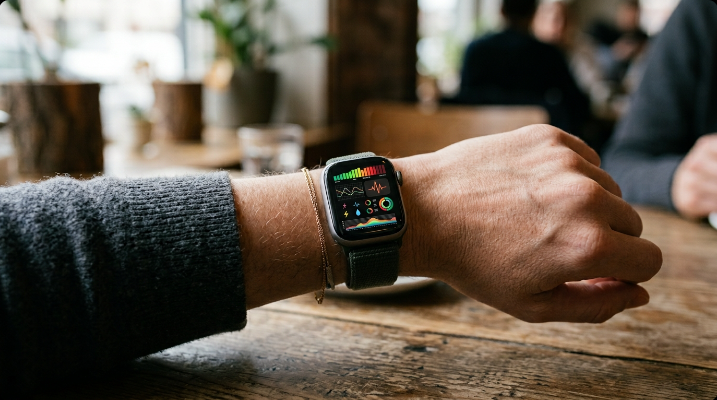
My smartwatch buzzed with a stress alert at 2:47 on a Tuesday afternoon, and my first reaction was mild annoyance, because I felt completely fine. I was just sitting at my desk answering emails, nothing unusual, no argument, no deadline panic. I dismissed it and kept working. Twenty minutes later I noticed my jaw was clenched, my shoulders were up near my ears, and I’d read the same paragraph of a client email four times without absorbing it. The watch had clocked something in my body a full twenty minutes before my own brain caught up to it, and that gap between what my nervous system already knew and what I was consciously aware of is the thing I can’t stop thinking about since.
What the Watch Actually Measures
My watch doesn’t detect “stress” directly. It tracks heart rate variability, the tiny fluctuations in time between heartbeats, along with resting heart rate drift and skin temperature, and runs those numbers through an algorithm that flags patterns associated with physiological arousal. It’s the same category of signal a good therapist trained in biofeedback would look for, just automated and strapped to my wrist all day. When my body shifts into a low-grade fight-or-flight state, heart rate variability drops in a specific, measurable way, well before I’d describe myself as “stressed” if you asked me directly. The watch isn’t reading my mind. It’s reading my autonomic nervous system, which apparently has better situational awareness than I do.
The Pattern I Didn’t Expect
After three months of paying attention to these alerts instead of dismissing them, a pattern emerged that surprised me: my highest stress readings weren’t during objectively hard moments, like a difficult client call or a tight deadline. They were during ordinary email triage, the kind of low-grade, low-stakes task I would have described as “relaxing busywork” if you’d asked me to characterize it. My body, it turns out, treats an overflowing inbox with the same physiological alarm as a mild threat, just quieter and more sustained, and I’d been marinating in that low simmer for hours every day without registering it as stress at all because nothing dramatic was happening.


Why This Matters More Than It Sounds
The gap between felt stress and measured stress is, I think, the actual finding here, more than any single data point. We’re generally taught to trust our own read on our emotional state, and for big, obvious feelings that’s fine. But for the low-level, chronic kind of physiological activation that doesn’t announce itself with a racing heart or sweaty palms, self-report is a genuinely bad instrument. I’d been unconsciously compensating for twenty minutes of elevated stress by feeling vaguely irritable and unfocused, attributing it to being tired or unmotivated, when my actual body was running a specific, detectable stress response the whole time and I had no idea.
The Data Behind the Feeling
This isn’t just a quirk of my particular device. Heart rate variability as a stress and recovery marker has decades of research behind it in sports science and, more recently, in consumer wearables, and multiple independent studies have found that people are surprisingly poor at accurately self-rating their own stress levels in real time compared to physiological markers, especially for the sustained, low-intensity kind rather than acute spikes. Market research on wearable adoption has also found that stress and recovery tracking has become one of the most-cited reasons people upgrade to newer smartwatch models in the US and Canada, ahead of step counting or workout tracking, which tells you something about how much people suspect they’re missing about their own internal state.
A Real Comparison: Two Different Afternoons
I ran an informal test on myself once I noticed the pattern. One afternoon I deliberately worked through email with notifications on, replying immediately to everything as it arrived. My watch logged elevated stress readings for nearly three straight hours. The next day, same volume of email, I batched it into two fifteen-minute windows and turned off notifications between them. Stress readings for the day dropped by roughly half, and I felt noticeably calmer by the evening, not because the workload changed but because the pattern of interruption did. I wouldn’t have believed the difference was that large without a number attached to it, because subjectively both days just felt like “a normal amount of email.”

Where the Technology Oversteps
I want to be honest about the limits here, because I think stress-tracking features get marketed with more confidence than the underlying science fully supports. My watch cannot tell the difference between the physiological signature of stress and the signature of, say, having just climbed a flight of stairs, drinking too much coffee, or simply being dehydrated, and it has occasionally flagged “high stress” moments that were actually just caffeine kicking in. I’ve learned to treat every alert as a prompt to check in with myself, not as a diagnosis, because treating a wearable’s stress score as gospel would be its own kind of unhealthy relationship with the device.
What Changed in How I Work
The concrete change I made was small: I now do a genuine two-minute check-in whenever the watch flags elevated stress, instead of dismissing the notification like I used to. Sometimes that means noticing I’ve been holding my breath while reading a tense email thread. Sometimes it means realizing I’ve had my shoulders hunched for forty-five minutes straight. The intervention is almost always simple, a few deep breaths, standing up, unclenching my jaw, but I never would have known to do it without an external prompt, because the whole point is that this kind of stress doesn’t announce itself to conscious attention on its own.
The False Alarm That Made Me Trust It Less
Not every alert has been accurate, and the misses taught me almost as much as the hits. Three weeks in, the watch buzzed with a stress notification while I was sitting perfectly calm on my couch watching a movie, heart rate elevated for no reason I could identify. I checked in with myself the way the app suggests, ran through its breathing prompt, and felt slightly ridiculous doing box breathing during a scene I wasn’t even tense about. It turned out, embarrassingly, that the movie had a jump scare about four minutes earlier that I’d already forgotten, and my body apparently hadn’t.
That single false alarm did more to calibrate my trust in the device than any of the accurate readings had. I realized the watch isn’t actually detecting stress in any psychological sense; it’s detecting a physiological pattern, elevated heart rate combined with reduced heart rate variability, that correlates with stress often enough to be useful but is also produced by caffeine, exercise recovery, a warm room, or, apparently, horror movie jump scares four minutes in the past. Treating every alert as gospel would have meant interrupting my day for signals that weren’t actually about my mental state at all.
So I stopped treating the notifications as verdicts and started treating them as questions. When it buzzes now, I don’t assume I’m stressed. I ask myself what’s actually going on, and about half the time the answer really is stress I hadn’t consciously registered yet. The other half, it’s a cup of coffee or a set of stairs. That distinction matters, because acting on the wrong half would train me to distrust my own instincts in favor of a wearable that’s making an educated guess, not a diagnosis.
How I Started Reading the Data Instead of Reacting to It
The bigger shift wasn’t in any single moment but in how I now look at the weekly trend graph instead of individual alerts. A single stress spike on a Tuesday afternoon tells me almost nothing useful. A pattern of spikes every Tuesday and Thursday around two in the afternoon, which is exactly what showed up after about six weeks of data, told me something concrete: those were my two weekly status meetings, and my body was reacting to them hours before I would have consciously admitted I found them stressful.
Once I saw the pattern laid out instead of buried in individual notifications, I changed how I prepared for those two meetings specifically, blocking off ten quiet minutes beforehand instead of running into them straight from another call. The spikes didn’t disappear, but they got smaller, and more importantly I stopped being surprised by them. I’d rather know in advance that Tuesday at two is going to be a hard hour than find out in the moment and wonder why I feel off.
I’ve come to think of the watch less as a stress detector and more as a slow, patient mirror. It doesn’t tell me anything about myself I couldn’t theoretically have noticed on my own. What it does is notice faster and more consistently than I do, and hand the pattern back to me in a form I can actually act on.
I’ve also started sharing the weekly trend view with my doctor during checkups, which felt strange the first time and now feels obvious. It’s not a diagnostic tool, and I’m careful not to treat it like one, but a six-month record of when my body reliably reacts as though it’s under strain is more useful context than my own memory of “I’ve been a little stressed lately,” which tends to smooth over the specifics. The watch doesn’t replace paying attention to myself. It just gives that attention somewhere concrete to land.
It’s a small shift in vocabulary, but an important one: I no longer ask “am I stressed,” a question that’s easy to answer wrong under pressure. I ask “what is my body doing right now, and why,” which turns out to be a much more honest question, and one the watch is far better positioned to help me answer than I am on my own most afternoons.
What I’d Tell Someone Considering This
I don’t think a stress-tracking smartwatch is a shortcut to being calmer, and I’m skeptical of framing any wearable as a wellness solution rather than a measurement tool. What it actually gave me was better information about a system, my own nervous system, that I’d been operating mostly blind to for my entire adult life. The watch buzzing at 2:47 that Tuesday didn’t stress me out. It told me something true about a state I was already in but hadn’t noticed, and twenty minutes is a long time to be tense without knowing it, multiplied across every ordinary afternoon I wasn’t paying attention before.
