I missed my dentist appointment in the spring. It was in my digital calendar, complete with a reminder the day before and another an hour before. I saw both notifications, swiped them away, and completely forgot. When the clinic called to ask where I was, I was sitting at my desk, looking directly at my calendar app, where the appointment block was sitting in plain sight.
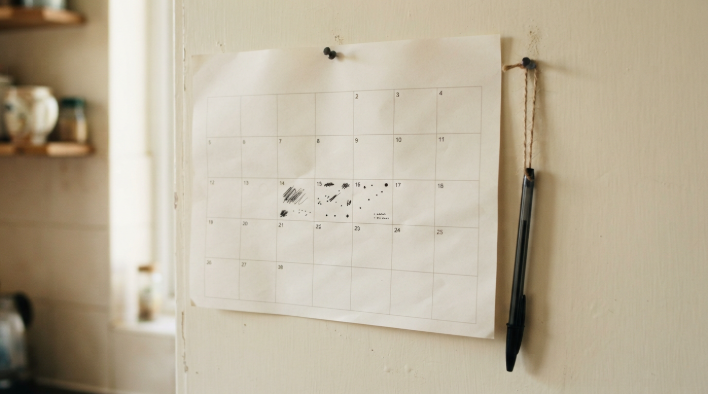
That small failure started an experiment that has now lasted six months. I bought a simple paper wall calendar, hung it in the kitchen, and began writing my most important commitments on it by hand, alongside my digital calendar. I thought it would last a couple of weeks before I gave up. Instead, it has become one of the most useful habits I have, and it has taught me something about how our brains deal with time.
My digital calendar was full, and I had stopped seeing it
My digital calendar is excellent at many things. It syncs across my devices, it lets colleagues send invitations, it handles time zones, and it reminds me about events automatically. For years, I thought it was the only calendar I needed.
But over time, it had become crowded. Work meetings, recurring reminders, shared family events, birthdays pulled in automatically from contacts, holidays, and invitations I had accepted without much thought all lived in the same place. Looking at a typical week, I saw a dense wall of coloured blocks. The important things and the trivial things looked almost identical.
Notifications had the same problem. My phone reminded me of so many things, from meetings to app updates to messages, that calendar alerts blended into the noise. I had trained myself to dismiss notifications quickly, and calendar reminders got dismissed along with everything else. The dentist appointment was not missing from my calendar. It was hidden in plain sight.
Why paper felt different almost immediately
The first week with the paper calendar, I only wrote down a few things: the rescheduled dentist appointment, a friend’s birthday dinner, a deadline at work, and a delivery I needed to be home for. Because I had to write each one by hand, I only wrote what really mattered. The calendar stayed sparse and clear.
That sparseness turned out to be its biggest strength. When I walked past the kitchen wall, I could see the whole month at a glance, and the handful of important events stood out immediately. There was no scrolling, no switching between views, no clutter. Just the month, and the few things in it that genuinely needed my attention.
There was also something about seeing it without choosing to. I never had to open an app or unlock a phone. The calendar was simply there every morning while I made coffee and every evening while I cooked. I absorbed my upcoming week almost passively, which is exactly what my digital calendar had stopped doing for me.
Handwriting helps memory, and there is research behind it
I was curious why writing things down felt so much more effective than typing them in, so I looked into it. Researchers have studied the difference between handwriting and typing for years, particularly in the context of note-taking and learning. Several studies suggest that writing by hand engages the brain more actively, which may help with memory and understanding.
One common explanation is that writing by hand is slower, which forces you to process and select information rather than simply transcribing it. Another is that the physical movement itself creates additional memory cues. I am not a scientist, and the research is still developing, but my own experience matched it closely. The appointments I wrote by hand, I simply remembered better, often without needing to look at the calendar at all.
There is also the act of deciding. When adding something to my digital calendar, it costs almost nothing, so I added everything. When writing on paper, I had to decide whether something deserved a spot. That small moment of judgment helped me understand my own priorities.

How I divide the work between the two
I did not abandon my digital calendar, and I would not recommend anyone does. It remains essential for work, for shared scheduling, and for anything involving other people’s invitations. What changed is that I now use the two calendars for different jobs.
The digital calendar is my complete record. Every meeting, reminder, and event goes there, because it needs to sync with other people and send alerts. It is the detailed, comprehensive system that handles logistics.
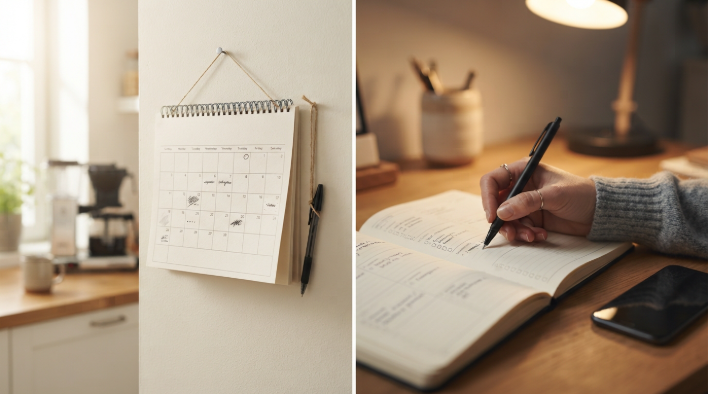
The paper calendar is my attention system. Only the important, non-routine commitments go there: appointments, deadlines, social events that matter, travel, and anything with real consequences if I forget it. Regular weekly meetings never go on paper. The paper calendar is not meant to be complete. It is meant to show me what matters.
Every Sunday evening, I spend about five minutes looking through the digital calendar for the coming week and copying anything important onto the paper one. That small ritual has become one of my favourite moments of the week. It gives me a calm overview of what is coming and forces me to think about the week before it starts.
The family effect
An unexpected benefit was how the paper calendar changed things at home. Before, our household schedules lived in separate phones. Shared digital calendars exist, of course, and we had tried one, but in practice, people forgot to check it or did not add their own events.
A calendar on the kitchen wall is impossible to ignore. Within a few weeks, other people in the house started adding their own events to it. A school trip, a work dinner, a visit from relatives. Conversations like “wait, you are away that weekend?” became much less common, because everyone could see the month at a glance.
It also became a small point of connection. Someone would notice an event and ask about it. Plans got discussed in the kitchen rather than through messages. It sounds minor, but having a shared, physical view of the household’s time made everyone feel a little more coordinated and a little more aware of each other’s lives.
Choosing the right paper calendar
It took me a little trial and error to find a paper calendar that actually worked. My first choice was a beautiful calendar with large photographs and tiny date boxes. It looked lovely on the wall, but there was barely room to write anything, and I found myself squeezing appointments into spaces the size of a postage stamp.
The second one was a plain monthly planner with large, empty squares for each day and a small notes column on the side. It was far less decorative, but far more useful. I could write the time, the event, and occasionally a short note like “bring documents” without running out of space.
I also learned to keep a pen attached to it with a piece of string. That sounds trivial, but a calendar you cannot immediately write on is a calendar you stop updating. The fewer steps between remembering something and writing it down, the more likely it is to actually end up on the wall.
The limits of paper
Of course, paper has obvious limitations. It does not remind you of anything when you are away from home. If I am out and someone asks whether I am free next Thursday, the paper calendar cannot help me. It does not sync, it cannot be searched, and it does not handle last-minute changes gracefully. Crossed-out events and arrows quickly make a month look messy.
It also requires discipline. If I skip my Sunday copying ritual, the paper calendar falls out of date, and a calendar you cannot trust is worse than no calendar. There have been a couple of weeks where I forgot, and the calendar lost some of its usefulness until I caught up.
That is why I think of the two calendars as partners rather than competitors. Paper handles attention and memory. Digital handles logistics, reminders, and coordination. Each covers the other’s weaknesses.

What this taught me about digital tools in general
This experiment made me think more broadly about how I use technology. Digital tools are often designed to do everything: store everything, remind you of everything, connect to everything. That completeness is powerful, but it can also create overload. When everything is recorded and everything sends notifications, nothing stands out.
Sometimes a simpler, more limited tool works better precisely because it is limited. A paper calendar cannot hold everything, so it only holds what matters. It cannot send notifications, so it does not compete for attention with every other app. Its constraints are exactly what make it useful.
I have started applying this idea elsewhere. I keep a short handwritten list of the three most important tasks for each day, even though I also use a digital task manager. I keep a small notebook for ideas, separate from my phone’s notes app. In each case, the paper version is not a replacement. It is a filter, a way of pulling the important few things out of the digital flood.
A calm view of time
There is one more benefit that is harder to measure. Looking at a paper month on the wall gives me a different feeling about time than scrolling through a digital calendar. Digital calendars tend to show one day or one week at a time, broken into hours and full of blocks. Time feels crowded, divided, and urgent.
The paper calendar shows a whole month, with plenty of empty space. Seeing the gaps, the evenings and weekends with nothing written, is quietly reassuring. It reminds me that my life is not only meetings and obligations. There is room in it. That sense of space was something I had lost without realizing it.
If you want to try it
If you have ever missed something important despite having it in your digital calendar, I would suggest trying a simple paper calendar alongside it. Choose one with enough space to write, hang it somewhere you see every day, and keep it sparse. Only write down what truly matters.
Set a regular time each week to transfer important events from your digital calendar to paper. Treat that time as a short planning session rather than a chore. And do not worry about making it look perfect. A few crossed-out lines are a small price for remembering what matters.
I have not missed a single important appointment since I started. My dentist, when I finally made it to the rescheduled visit, was pleased to hear it. The calendar on my kitchen wall now has next month’s appointment written on it, in my own slightly messy handwriting. I have a feeling I will remember it.
