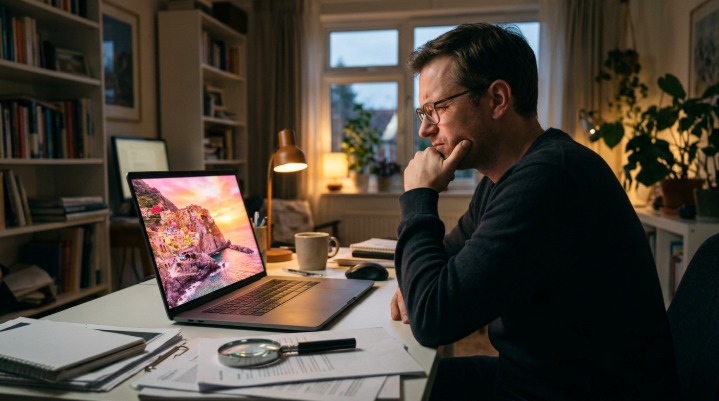
A friend sent me a photo last month of a beautiful coastal village at sunset. Whitewashed houses, a small harbor, fishing boats glowing in orange light. “We have to go here next summer,” she wrote. I agreed immediately, then spent twenty minutes trying to find where it was. Eventually, I realized why I could not find it: the village did not exist. The image had been generated by AI, shared by an account that posted dreamy travel pictures without saying they were artificial.
It was a small, harmless moment, but it stayed with me. In the past year or so, I have noticed myself pausing more and more before believing any image I see online. Is that photo real? Was it edited? Was it generated entirely? This new habit of doubt has changed how I look at pictures, and I wanted to understand what it means, both for me and for the way we share information.
How quickly image generation became ordinary
Only a few years ago, AI-generated images were easy to spot. Faces looked waxy, hands had too many fingers, text in the background turned into nonsense, and lighting felt subtly wrong. People shared them as curiosities, often laughing at the mistakes.
That era passed quickly. Today’s image generators produce pictures that look like professional photography, casual phone snapshots, vintage film, or anything in between. Many of the old giveaways have been fixed. Hands usually have the right number of fingers. Text is often readable. Lighting and shadows are convincing. For most people scrolling quickly through a feed, a generated image is indistinguishable from a real photo.
The tools have also become widely available. Generating a realistic image no longer requires technical skill or expensive equipment. A sentence of description is enough. That accessibility is wonderful for creativity, and it also means that realistic fake images can be produced by anyone, for any reason, in seconds.
The harmless fakes and the harmful ones
Most AI images I encounter are harmless. Fantasy landscapes, imaginative art, product mockups, funny scenarios, illustrations for blog posts. Many are clearly labeled as AI-generated, or obviously fictional. These do not bother me at all. They are a new creative medium, and some of them are genuinely beautiful.
The problem is the category of images designed to look like documentation: photos presented as evidence of real events, real places, or real people. A fake picture of a disaster, a fabricated image of a public figure doing something they never did, or a staged scene presented as news can spread widely before anyone checks it. Even when such images are later corrected, the first impression often sticks.
There is also a quieter harm in the middle: images like my fake village, which are not malicious but are shared without context. People plan trips, form opinions, or feel envious of lives and places that do not exist. Each individual case seems trivial, but together they blur our sense of what the real world looks like.

The strange side effect: doubting real photos
What surprised me most was not that I started doubting fake images. It was that I started doubting real ones too. A friend posted a stunning photo of an aurora she saw on holiday, and my first thought was “is this real?” It was. She had stood in the cold for three hours to take it. My suspicion felt unfair to her.
Researchers sometimes talk about this as a kind of liar’s dividend: when fakes become common, people can dismiss genuine evidence by claiming it might be fake. If every image could be generated, then any inconvenient photo can be waved away. That is a troubling development for journalism, for courts, and for ordinary trust between people.
On a personal level, it also takes some joy out of looking at pictures. Part of the pleasure of a remarkable photo is knowing that someone was there, that the moment actually happened. When I cannot be sure, the image loses some of its emotional weight, even if it is completely genuine.
How I check images now
I have developed a few habits for images that matter, meaning those presented as news, as evidence, or as something I might act on. The first is to look for the source. Who originally posted it? Is it a known photographer, a news organization, or an anonymous account that posts many similar images? Images without a clear origin deserve more caution.
The second habit is a reverse image search. Most search engines allow you to upload an image or paste its address to find where else it appears online. This often reveals the original source, or shows that the image has been debunked, or that it first appeared on an account known for generated content.
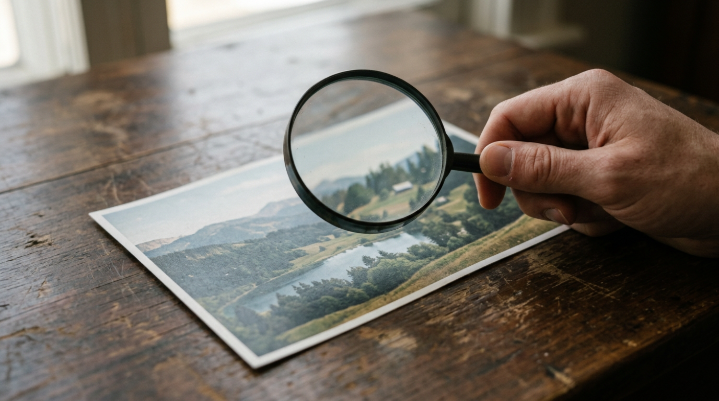
The third is to look closely at details. Even good generated images can contain small inconsistencies: reflections that do not match, signs with odd lettering, objects that blend into each other, or architecture that does not quite make sense. These clues are getting harder to spot, so I treat them as hints rather than proof.
Finally, for important claims, I look for multiple independent sources. A real major event is usually photographed by many people from different angles. If a dramatic image exists only in one version, shared by one account, that is a reason to wait before believing or sharing it.
Why our brains are easy to fool
Part of the reason generated images work so well is that our brains are built to trust what we see. For most of human history, seeing something with your own eyes was the strongest possible evidence. Photography inherited that trust. Even after decades of photo editing, most of us still treat a photograph as a record of something that happened.
We also process images much faster than text. A picture triggers an emotional reaction in a fraction of a second, long before we have a chance to think critically. That is why dramatic images spread so quickly online. By the time we wonder whether something is real, we have often already felt angry, amazed, or moved, and that feeling shapes how we judge it.
Knowing this has helped me a little. When an image makes me feel something strongly, especially outrage or surprise, I now treat that feeling as a signal to slow down rather than a reason to share. Strong emotion is exactly what a misleading image is designed to produce.
Labels, watermarks, and their limits
Technology companies and industry groups have been working on ways to mark AI-generated content. Some image generators add invisible watermarks or metadata indicating that an image was created by AI. Some social platforms add labels when they detect such content. There are also efforts to attach verifiable information about where a photo came from and how it has been edited, from the camera onward.
These efforts are useful, but they are not complete solutions. Metadata can be stripped when an image is screenshotted or re-saved. Not every generator uses watermarks. Detection tools make mistakes in both directions, sometimes flagging real photos as fake and missing generated ones. Labels help, but they cannot replace our own judgment.
Being a responsible sharer
The experience with the fake village made me think about my own role. I have certainly shared images in the past without checking where they came from. Every time I share something, I add a little credibility to it, because my friends trust me more than they trust a random account.
Now, I try to follow a simple rule: if I cannot tell where an image came from, I either do not share it or I share it with a note saying I am not sure it is real. If I share AI-generated images I find beautiful or funny, I say they are AI-generated. It costs nothing and helps keep the information around me a little cleaner.
I have also started gently mentioning it when friends share images that seem generated. Not in a lecturing way, just a quick “I think this one might be AI, the village does not seem to exist.” Most people appreciate it, because nobody likes being fooled.
Talking to younger and older relatives about it
I have noticed that different generations in my family react to AI images very differently. My younger cousins are often quicker to suspect that an image is generated, partly because they have played with image tools themselves and know how easy it is. My older relatives tend to trust images more, especially when they are shared by someone they know in a family group chat.
Neither approach is perfect. Assuming everything is fake can be as misleading as assuming everything is real. So we started talking about it openly, sharing examples of convincing fakes and real photos that looked fake. These conversations were more useful than any warning, because they turned media literacy into a shared family habit rather than a lecture.
Not everything needs to be investigated
It would be exhausting to treat every picture as a potential deception, and I do not think that is healthy. Most images I see do not need checking. A friend’s photo of their lunch, a family picture, a meme: I can simply enjoy them. The doubt only needs to switch on when an image is being used to tell me something important about the world.
Finding that balance has been the real lesson. Healthy skepticism is about matching the level of checking to the stakes. A pretty landscape I will never visit does not matter much. A shocking image about a news event, or a photo someone uses to ask me for money, deserves careful attention.
What we still have
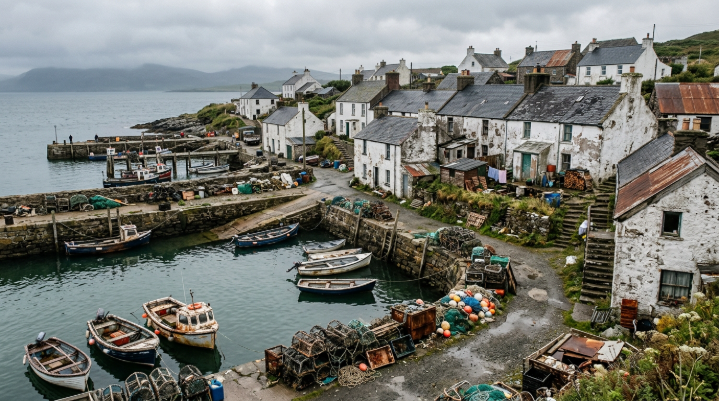
We did, in the end, plan a trip to the coast. Not to the village in the generated image, but to a real one we found together, with real whitewashed houses and a real harbor. It is not as perfect as the AI version. The houses need painting, the harbor smells of fish, and the sunsets depend on the weather.
But it exists. We will be able to walk its streets and take our own photos, imperfect and real. In a world where perfect images can be produced in seconds, I find myself valuing that imperfection more than ever. The real thing does not need to be flawless. It only needs to be true.
