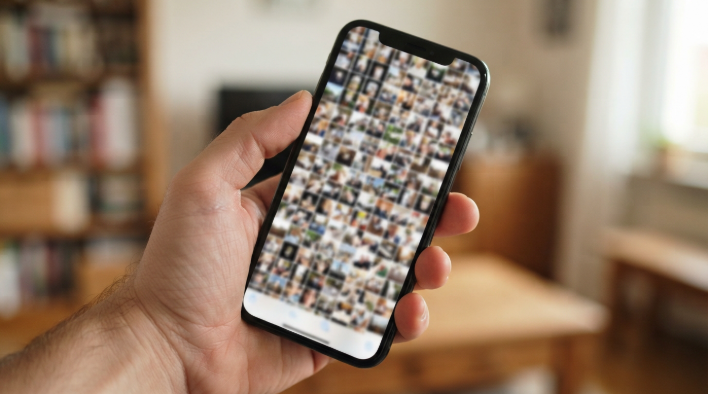
I recently needed to free up space on my phone, so I opened my photo library and filtered by screenshots. There were more than four thousand of them. I scrolled back through a few years of my life in tiny rectangles: a funny message from my brother, a recipe I never made, a train ticket, a map of a hotel location, a tweet I wanted to remember, a conversation I wanted to show a friend, an error message, a meme, another meme, and a surprising number of screenshots of other screenshots.
It struck me that screenshots have become one of the main ways I record, share, and even tell stories about my life. I am clearly not alone. Group chats are full of them. Social media feeds are full of them. Entire conversations now happen through screenshots of other conversations. I wanted to understand how this small, simple function became such a central part of digital culture, and what it says about how we communicate.
A tool nobody designed for storytelling
The screenshot began as a practical feature. It was a way for people to capture exactly what was on their screen, often to show a technical problem or save a piece of information. For years, taking a screenshot on a computer was slightly awkward, and on early phones it was not always obvious how to do it at all.
Once smartphones made screenshots easy, with a simple button combination or gesture, people started using them for everything. And because smartphones became the place where so much of our lives happen, from conversations to news to shopping, the screenshot became a way to capture almost any moment of digital life instantly.
What nobody quite predicted was how social the screenshot would become. It turned into a way of saying “look at this” without needing to explain. A single image of a message, a comment, or a post can carry a whole story, complete with its original wording, formatting, and context. It is proof, evidence, and punchline all at once.
Why screenshots beat links
You might wonder why people screenshot things instead of simply sharing links. The answer, I think, comes down to a few practical and emotional reasons.
First, screenshots work across platforms. A link to a post on one app might not open properly for someone who does not use that app, or might require logging in. A screenshot is just an image, and every messaging app can display images. It removes friction completely.
Second, screenshots capture a specific moment. Online content changes constantly. Posts get edited or deleted, prices change, articles are updated. A screenshot freezes exactly what you saw, which is especially important when the point is to show something that might disappear. People have learned that if they want to remember or prove something, a screenshot is safer than a link.
Third, screenshots let you curate. You can crop to the exact part you want, highlight a single line, or combine several images into one. A link sends people to the whole thing. A screenshot says: this part, right here, is what matters.

The screenshot as a new kind of storytelling
Spend any time in a group chat and you will see screenshots used as narrative devices. Someone shares a screenshot of a strange message they received, and the whole chat reacts. A friend posts a series of screenshots from a dating app conversation, and everyone offers commentary. A family member shares a screenshot of a news headline, starting a discussion that runs all evening.
In these moments, the screenshot is not just information. It is a story being retold, with the original as the central scene and the group’s reactions as the commentary around it. The person sharing it is a kind of narrator, choosing what to show and when.
On social media, this has become its own format. Screenshots of text posts, of comment exchanges, of funny notifications, and of chat conversations are shared and reshared across platforms. Some of the most widely circulated content online consists of nothing more than screenshots, often passed around so many times that the original source is long forgotten.
The uncomfortable side of screenshot culture
There is a darker side to this, and it is worth being honest about. The ease of screenshots means that almost nothing we write online is truly private. A message sent to one person can be screenshotted and shared with a group, or with the whole internet, in seconds. Most of us have probably, at some point, shared a screenshot of a message that the original sender would not have wanted others to see.
This has changed how people write. Many people, especially younger users, write with the awareness that anything might end up screenshotted. That can make conversations more guarded and less spontaneous. Jokes, complaints, and vulnerable moments feel riskier when you know they could be captured and passed along out of context.
Some apps have responded by notifying users when someone takes a screenshot, or by blocking screenshots in certain features. These measures help a little, but they cannot fully solve the problem, because anyone can simply take a photo of their screen with another device. The real protection is social: a shared understanding that some things should not be shared.
Screenshots can also be misleading. It is easy to crop out context, and it is easy to fake a screenshot entirely. Fake screenshots of messages, posts, and headlines circulate regularly, and because screenshots feel like evidence, people tend to trust them more than they should. Learning to be skeptical of screenshots has become part of basic digital literacy.
Screenshots as personal memory
Beyond sharing, screenshots have become a kind of personal archive. Looking through my own collection, I realized many of them are things I captured for myself, not to share. Directions I needed to access offline. Confirmation numbers. Quotes I liked. Recipes. Clothes I was thinking about buying. Moments in conversations that made me happy.
In a strange way, my screenshot folder tells a truer story of my daily life than my carefully chosen photos. Photos capture special moments I decided were worth remembering. Screenshots capture the ordinary things I needed, wanted, or found funny on a random Tuesday. Scrolling through them felt like reading an unintentional diary.
Some of those screenshots are now surprisingly meaningful. A screenshot of a sweet message from a friend I have since lost touch with. A screenshot of a video call with my family during a difficult year. A screenshot of the first message from someone who later became very important in my life. At the time, I captured them almost without thinking. Now they feel like small pieces of history.
How different generations use screenshots
When I asked around, I found that people of different ages use screenshots in surprisingly different ways. My parents mostly screenshot practical things: bank confirmations, instructions from a customer service chat, a recipe from a video. For them, a screenshot is a digital version of writing something down on paper.
My younger cousins, on the other hand, use screenshots almost like a language. They screenshot a moment in a video game, a line of a song on a streaming app, a comment on a post, and send it with no explanation at all. The screenshot itself is the message, and everyone in their group understands what it means. It is closer to a reaction than a record.
Somewhere in between are people like me, who use screenshots for both. What unites all of us is that the screenshot has become a default reflex. Whatever age we are, when something on a screen seems worth keeping or sharing, our fingers reach for those buttons almost automatically.
The clutter problem
Of course, four thousand screenshots is also a lot of clutter. Most of mine were useless the moment I stopped needing them: old tickets, expired codes, directions to places I had already visited. They took up storage space and made it harder to find the screenshots that actually mattered.
Phone makers have noticed this. Some photo apps now automatically separate screenshots from regular photos, suggest cleaning up old ones, or can search the text inside screenshots. Being able to search for a word and find a screenshot containing it has been a real help. I found an old address I needed just by typing part of the street name.
I spent an evening cleaning out my collection. I deleted thousands of screenshots that no longer served any purpose, and moved a few hundred meaningful ones into a separate album. It felt surprisingly satisfying, a bit like clearing out a messy drawer and finding a few forgotten treasures at the bottom.
What screenshots say about us
The popularity of screenshots reveals something about modern digital life. We live across many apps and platforms that do not talk to each other very well. The screenshot has become the universal translator, the one format that works everywhere. It is a workaround that turned into a habit, and then into a culture.
It also reveals our relationship with impermanence. We know that digital content can vanish, change, or be deleted. Screenshots are our way of holding on, of saying: I saw this, and I want to keep it. In a world where so much feels temporary, the screenshot is a small act of preservation.
And perhaps most of all, screenshots show how much we want to share our experiences with each other. Behind almost every shared screenshot is the same simple impulse: you have to see this. Whether it is a funny message, a frustrating email, or a surprising headline, we want the people we care about to see what we saw, exactly as we saw it.
A few habits I kept
After my big cleanup, I adopted a few simple habits. I delete practical screenshots, like tickets and codes, as soon as I no longer need them. Once a month or so, I spend a couple of minutes clearing out anything that has built up. And when I screenshot something meaningful, I add it to a dedicated album right away so it does not get lost among the clutter.
I have also become more thoughtful about sharing screenshots of private conversations. Before sending one, I ask myself whether the person who wrote it would be comfortable with it being shared. Often the answer is yes, especially for funny or harmless moments. Sometimes the answer is no, and in those cases I describe what happened instead of showing it.
Screenshots are a small feature that grew into something much bigger than intended. They are how we remember, how we share, how we prove, and increasingly, how we tell our stories. My folder is much smaller now, but it is also much more meaningful. Every screenshot in it is there because it tells a small part of a story I want to keep.
