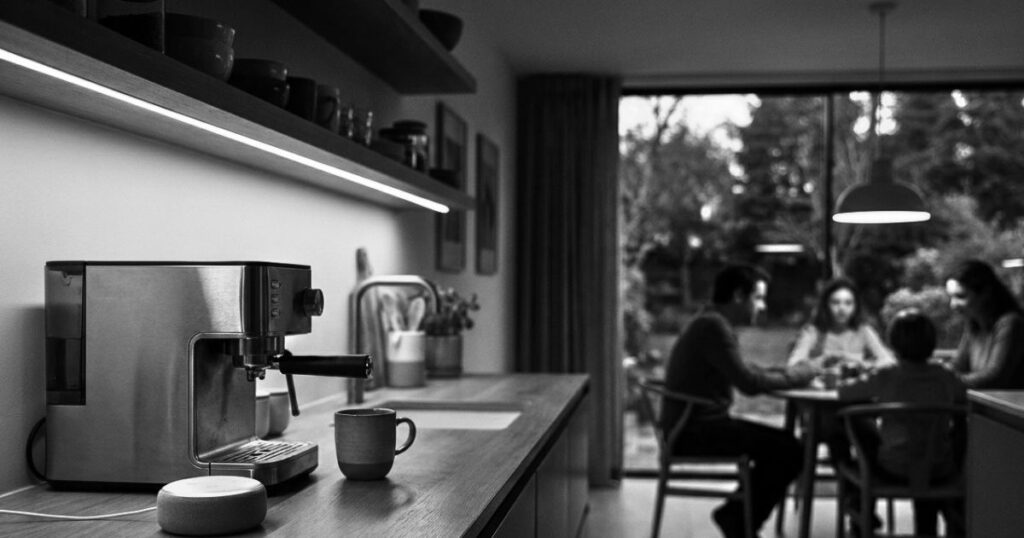
A few months ago, a friend told me something that stuck with me. She said her ten-year-old son no longer asks her what the weather is like before school. He asks the kitchen. Not her but the small speaker sitting near the coffee maker. And when he wants the porch light on, he doesn’t call out to his dad in the next room. He just says it into the air, and it happens.
She wasn’t complaining, exactly. It was more like she’d noticed a shift and didn’t quite know what to make of it. That conversation is the reason I started paying closer attention to how smart home tech has crept into the small, ordinary exchanges that used to happen between people, not between people and devices.
The Convenience Nobody Argues With
It’s hard to make a case against smart home technology on the surface. Lights that turn off when nobody’s in the room save energy. Thermostats that learn your schedule save money. Video doorbells let you see who’s outside without walking to the door. None of this is frivolous – it solves real, unglamorous problems that used to eat up small amounts of time and attention every single day.
That’s exactly why it spread so fast. Unlike a lot of consumer tech trends that rely on novelty, smart home devices earned their place by being genuinely useful in mundane ways. Nobody buys a smart plug because it’s exciting. They buy it because they’re tired of walking downstairs to turn off a lamp. The appeal isn’t aspirational, it’s practical, and practical things tend to stick around long after the initial excitement of a product launch fades.
That practicality is also what makes the trend easy to underestimate. A single smart bulb or speaker looks like a minor convenience, barely worth discussing. But households rarely stop at one device. A speaker in the kitchen leads to a smart plug in the living room, then a video doorbell, then a thermostat that adjusts itself before anyone touches it. Each addition seems small on its own. Together, they add up to a home that behaves differently than the one most adults grew up in — one that anticipates needs instead of waiting to be asked.
But convenience has a way of rearranging things around it without asking permission first. Nobody sits down and decides that a device should start answering questions that used to go to a parent or a sibling. It just happens, gradually, as each new gadget takes over one more small task that used to require a person.
Who You Talk To Changes When a Room Can Answer

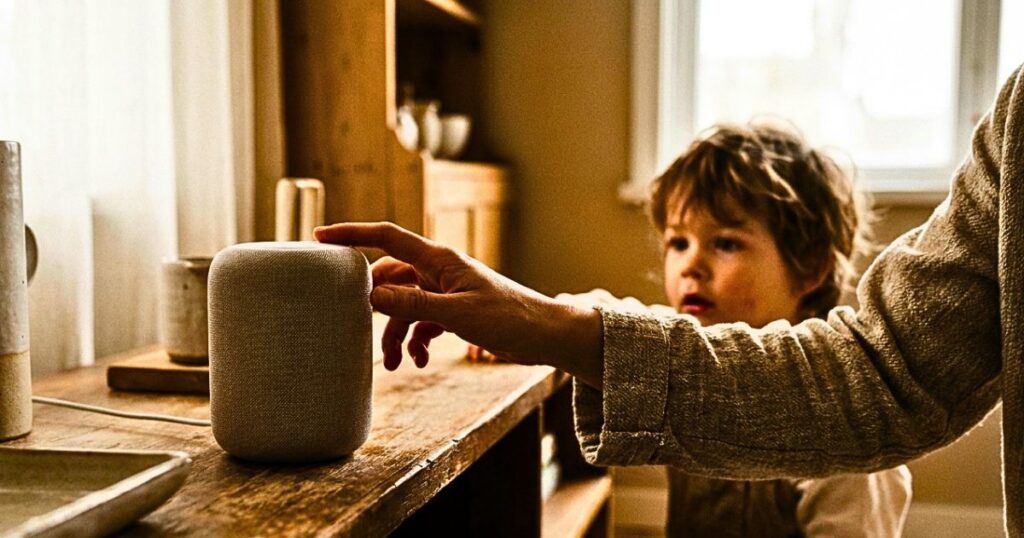
Here’s the part that doesn’t get talked about enough: a lot of household communication used to be functional. “Can you turn that off?” “What time is it?” “Did you lock the door?” These weren’t deep conversations, but they were still small moments of contact between people — a reason to glance at each other, respond, maybe follow up with something else.
When a smart speaker can answer those same questions, that tiny reason to interact disappears. It’s not dramatic. Nobody notices the day it happens. But multiply that by dozens of small exchanges a week, over months, and you start to see families where the ambient, low-stakes chatter that used to fill a house has been quietly rerouted to a device sitting on a shelf.
I don’t think this is inherently bad. But it is a real change, and it’s worth naming instead of pretending nothing shifted. It’s the same quiet erosion I noticed while writing about “The Slow Death of Waiting: How Tech Rewired Our Patience” — small habits changing before anyone consciously decided they should.
Kids Are Adapting Faster Than Anyone Expected

The generational gap here is sharper than with most tech trends. Kids who grow up with a smart speaker in the kitchen don’t experience it as a novelty — it’s just part of how the house works, the same way a light switch is. That means their instinct to direct a request toward the device, rather than a parent or sibling, forms early and naturally.
This shows up in small but telling ways. A child asking the house for a bedtime story instead of a parent. A teenager setting a timer through a voice assistant rather than asking a sibling to remind them. None of these moments look concerning in isolation. Together, they suggest that some households are outsourcing not just tasks, but small rituals of connection that used to require a person on the other end.
Parents I’ve talked to have mixed feelings about this. Some see it as harmless efficiency. Others worry, more quietly, that their kids are getting comfortable directing requests at something that can’t get annoyed, can’t say “not right now,” and never needs to be asked twice.
There’s a version of this worth sitting with a little longer. Asking a parent for something and waiting for a response, even a slightly annoyed one, teaches a kind of patience and social calibration that asking a device simply doesn’t. A device answers immediately, consistently, and without any social cost. That’s convenient, but it also removes a small, repeated lesson in reading another person’s mood, timing a request well, or accepting “not right now” as an answer. None of this means children raised around smart speakers will struggle socially. It just means one more small rep of everyday social practice has quietly moved off the schedule.
Some families have noticed this drift on their own and responded with simple house rules — no voice assistant requests during dinner, or a rule that certain questions still have to go to a person first. These aren’t dramatic interventions. They’re small, deliberate corrections to a default that crept in without anyone choosing it.
The Devices That Listen Change How Rooms Feel
There’s also a subtler shift that has nothing to do with who talks to whom, and everything to do with how people behave when they know a device is always listening. Conversations in rooms with smart speakers tend to be slightly more self-aware, even if nobody says it out loud. People choose words a little more carefully. Some households have unspoken rules about not discussing certain things near “the speaker.”
This isn’t paranoia — it’s a reasonable response to living with a microphone that’s technically always on standby. And it changes the texture of a room in a way that’s hard to measure but easy to feel. A kitchen that used to be a place for unfiltered venting after a bad day becomes, subtly, a place where people edit themselves first.
The Generational Split in How This Feels
Older adults who added smart speakers to an already-established household tend to experience this differently than families raising kids alongside the technology. For someone who spent decades having ordinary conversations without a device in the room, a smart speaker is an addition — something new layered onto old habits. They notice the shift because they have something to compare it to.
For a child born into a house that already has one, there’s no “before.” The device isn’t an addition to their world, it’s simply part of how the world works, the same way a television or a refrigerator is. This is part of why the generational divide on this topic is sharper than it looks at first glance. It’s not that older adults are more thoughtful about technology and younger people aren’t. It’s that one group is adapting to a change, and the other is growing up inside it without ever experiencing the alternative.
That distinction matters for anyone trying to make sense of survey data or anecdotal complaints about smart homes and family life. A grandparent uneasy about a grandchild talking to a speaker isn’t necessarily being old-fashioned. They’re noticing a genuine structural change that’s invisible to someone who never knew a different version of the room.
Where the Trade-Off Actually Shows Up
The honest version of this story isn’t “smart homes are ruining families.” It’s more specific than that. The trade-off shows up most clearly in three places:
First, in the disappearance of small requests that used to require a person. Second, in how quickly children adapt to treating a device as a default answer source, sometimes before they’ve developed the patience to ask a person and wait for a response. Third, in the low hum of self-awareness that comes from living somewhere that’s always technically listening, even when nobody’s worried about it directly.
None of these are catastrophic. But they’re real, and families who notice them tend to make small adjustments — deliberately asking a person instead of the speaker sometimes, or having device-free rooms where the old, slower way of asking still applies.
Why This Trend Isn’t Slowing Down
Despite all this, adoption keeps climbing, and it’s not hard to see why. Smart home devices have gotten cheaper, easier to set up, and more capable of handling genuinely useful tasks — security, energy management, accessibility for people with mobility issues. For a lot of households, especially ones with older or disabled family members, this technology isn’t a lifestyle choice. It’s a meaningful improvement in daily independence.
That’s worth remembering before this turns into a simple story about technology replacing connection. In some homes, a smart speaker gives an aging parent the ability to call for help, check on a delivery, or manage medication reminders without depending on someone else being present. That’s not a loss of connection — it’s a different kind of support filling a real gap, something AARP has pointed to when discussing how voice technology can extend independent living for older adults.
The Quiet Adjustment Happening in Homes Right Now
What seems to be happening isn’t a wholesale replacement of human interaction. It’s more like a redistribution. The small, functional exchanges that used to require a person now often don’t. What’s left is more space — sometimes filled with better, more intentional conversation, and sometimes just filled with more silence, because nobody automatically refills it.
That’s the part that depends entirely on the household. Smart home tech doesn’t decide whether a family talks more or less. It just removes the automatic, low-effort reasons they used to talk without thinking about it. Whether that space gets filled with something better is, as usual, up to the people in the room — not the device on the shelf.
Frequently Asked Questions
Does having a smart speaker actually reduce conversation at home? It tends to reduce small, functional exchanges — requests like turning off lights or checking the time — rather than deeper conversation. Families who notice this often compensate by being more deliberate about talking to each other for non-functional reasons.
Are children more affected by this shift than adults? Generally yes, since kids who grow up with voice assistants form habits around them earlier and treat directing requests to a device as normal, rather than as something new.
Do smart home devices always listen to conversations? Most are designed to activate only after a wake word, but they remain in a standby listening state to detect that word, which is why many people naturally become more self-aware in rooms with these devices present.
Is this trend a downside of smart home technology overall? Not necessarily. For many households, especially those with elderly or disabled family members, smart home tech provides real independence and support that outweighs the trade-offs in day-to-day chatter.
