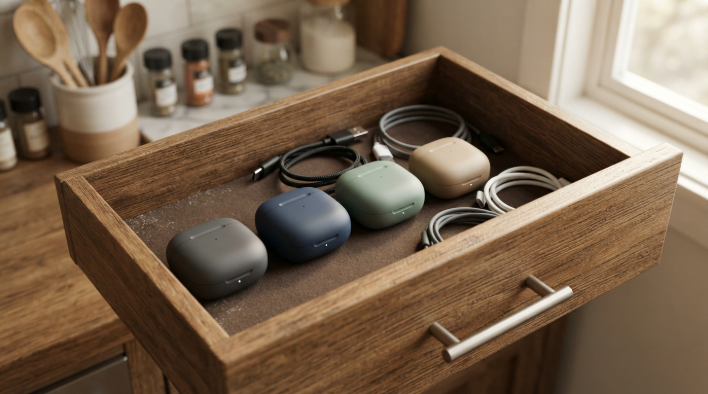
I found them in a kitchen drawer while looking for batteries: three pairs of wireless earbuds, each in its little charging case, each one still working more or less fine. Next to them was a fourth case whose earbuds had long since disappeared. Four pairs in about five years. I held them in my hand and realized that I could not clearly explain why I had bought most of them.
That drawer started a small investigation into my own habits. Wireless earbuds have become one of the most frequently replaced gadgets many of us own, and I wanted to understand why. Were they really wearing out, or was something else going on? What I found changed how I buy them, and I suspect it applies to a lot of other small tech too.
Why earbuds feel so disposable
The first thing I learned is that earbuds are, in a physical sense, genuinely hard to keep for a long time. The batteries inside each bud are tiny. Because they are so small, they go through charging cycles quickly, and like all lithium-ion batteries, they gradually lose capacity with every cycle. After two or three years of daily use, a pair that once lasted five hours might last two.
Unlike a phone or a laptop, most earbuds are not designed to have their batteries replaced. They are sealed, often glued, and so small that opening them without damage is almost impossible for an ordinary person. So when the battery fades, the whole product effectively reaches the end of its life, even if every other part works perfectly.
Then there is loss. Earbuds are small, easy to drop, and easy to leave behind. One pair of mine went missing on a train; another fell down a gap between floorboards. Replacing a single lost bud is sometimes possible but often expensive enough that buying a new pair feels more sensible. That combination of small batteries and easy loss makes earbuds feel almost designed to be replaced.
But batteries were not the real reason I upgraded
When I went through my pairs one by one, I had to admit something uncomfortable. Only one of them had actually been replaced because of a failing battery. The others were replaced because a new model came out with a feature I thought I wanted.
The second pair had slightly better noise cancellation. The third had a new transparency mode and a more comfortable fit. The fourth, the one I was using now, had a feature that adjusted the sound based on my ears. Each upgrade felt justified at the time. Looking back, the improvements were real but small, and the older pairs would have served me perfectly well for another year or two.
I think this happens because earbuds sit in a sweet spot for impulse upgrading. They are expensive enough to feel like a treat, but cheap enough compared with a phone or laptop that you can justify buying them without much thought. And because they are personal and used every day, a small improvement can feel meaningful.


What the new features were really worth
To be fair to myself, some of the upgrades were genuinely useful. Noise cancellation made a real difference on flights and noisy commutes. Better call quality helped when I started working from home more. A more secure fit meant the buds stopped falling out when I exercised.
But I tried a small test. I charged up my oldest working pair and used it for a week instead of my newest one. The noise cancellation was weaker, and the case was bulkier. Beyond that, I honestly struggled to tell the difference in daily listening. Music sounded good. Podcasts sounded fine. Calls were clear enough. The features I had paid extra for were mostly things I used occasionally, not every day.
That week taught me the difference between improvements I notice in a review and improvements I notice in my life. They are often not the same. Reviewers test earbuds side by side, looking for differences. In ordinary life, you use one pair at a time, and your brain adjusts quickly to whatever you are listening through.
The hidden environmental cost of tiny gadgets
Looking at that drawer, I also started thinking about where old earbuds go. Their small size makes them easy to forget about, but it also makes them difficult to recycle. They contain batteries, small circuit boards, magnets, and plastic, all packed together in a way that is hard to separate. Many end up in household waste, where their batteries can be a fire risk in collection trucks and sorting facilities.
Individually, one pair of earbuds is a tiny amount of waste. But hundreds of millions of pairs are sold worldwide every year, and many of them are replaced every couple of years. The overall pile is not small at all. It made me a little uncomfortable to realize I had contributed four pairs to it in five years without once thinking about what happened afterward.
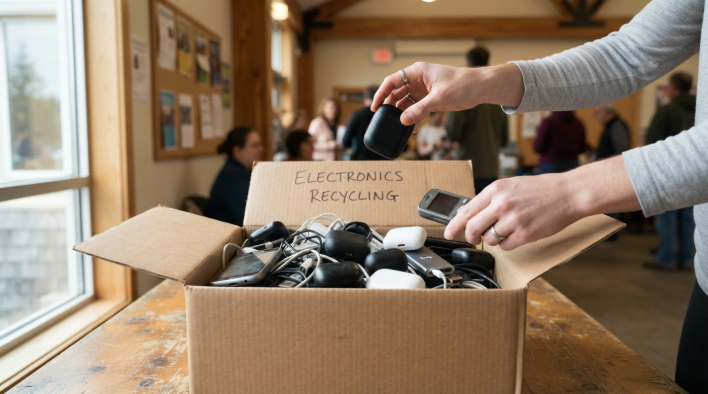
Some manufacturers and electronics shops now run take-back programs, and many local recycling centers accept small electronics with batteries. It takes a bit of effort to find the right place, but it is far better than throwing them in the bin. I eventually took my old pairs, and the orphaned case, to an electronics recycling point near my home.
How I buy earbuds now
After all this, I set myself a simple rule: I only replace earbuds when they stop doing their job, not when something newer appears. If the battery no longer gets me through my normal day, or a bud is lost or broken, I replace them. If they still work, I keep using them.
When I do buy a new pair, I now look for a few specific things. First, whether the manufacturer offers battery replacement or repair services, even for a fee. A few do, and it can extend the life of a pair considerably. Second, whether individual buds and cases can be replaced if one gets lost. Third, how good the fit is, because comfort matters more to daily use than most technical specifications.
I also pay more attention to how I charge them. Keeping batteries from sitting at full charge or completely empty for long periods can help them last longer. Some earbuds and phones now include optimized charging settings that do this automatically. It is a small habit, but it can add months to a battery’s useful life.
What marketing does to our sense of “old”
Part of what makes upgrading feel necessary is the way new products are announced. Every launch frames the previous model as a problem that has now been solved. The old noise cancellation suddenly sounds weak. The old battery life suddenly sounds short. Nothing about my earbuds changed on launch day, but my perception of them did.
I noticed this most clearly with a feature my current pair already had. A newer model advertised an improved version of it, and for a few days my existing earbuds felt slightly outdated, even though they were working exactly as they had the week before. The product was the same. The story around it had changed.
Once I recognized that pattern, it lost a lot of its power over me. Now, when I feel the pull of a new model, I remind myself that the feeling of obsolescence usually arrives before any actual obsolescence. My earbuds do not know a new version exists. They just keep playing music.
Cheaper earbuds are a surprisingly good option
Another thing I learned is that the gap between expensive and affordable earbuds has shrunk significantly. A few years ago, cheaper wireless earbuds often had poor connections, weak batteries, and flat sound. Today, many budget and mid-range pairs are genuinely good, with decent sound, reasonable noise cancellation, and solid battery life.
For me, this changes the calculation around loss and wear. If I am going to use earbuds at the gym, on public transport, and in places where they might get lost, a reliable affordable pair might make more sense than a premium one. I kept one nicer pair for flights and focused listening at home, and I use a cheaper pair for everyday wear. Losing the cheaper pair would be annoying, but not painful.
The small pleasure of making things last
There is a quiet satisfaction in using something until it is genuinely worn out. I had forgotten that feeling with electronics, even though I still feel it with a favorite pair of shoes or a well-used kitchen knife. Keeping earbuds longer brought a little of that back.
I clean them more carefully now, with a soft brush and a dry cloth, because clogged speaker mesh makes them sound worse and tempts you to replace them. I keep the case in one specific pocket so I stop losing it. None of this is complicated. It is just the kind of care we give to things we expect to keep, rather than things we expect to throw away.
A lesson that goes beyond earbuds
The more I thought about the drawer, the more I recognized the same pattern elsewhere. Smartwatches, fitness trackers, chargers, small speakers, even keyboards and mice. So much of our tech is replaced not because it has stopped working, but because a slightly better version has appeared. Each individual purchase seems reasonable. Together, they add up to a lot of money and a lot of waste.
What helped me most was asking one question before buying: what specific problem will this solve that my current device cannot? If I cannot answer that clearly, I usually do not need the new thing. Sometimes the answer is real, like a failing battery or a genuinely important new feature. Often, it is just curiosity or boredom dressed up as need.
The drawer, one year later
It has been about a year since I cleaned out that drawer. There is now just one spare pair in it, an older model I keep as a backup in case my main earbuds run out of battery or get lost. My main pair is the same one I was using when I started this little project. Its battery is a little weaker than it used to be, but it still lasts through my day.
When a new generation of earbuds from my usual brand was announced a few months ago, I read the reviews with interest, and then I closed the tab. The new features sounded nice. My old earbuds still work. For now, that is enough, and it feels surprisingly good to be satisfied with something I already own.
If you have a drawer like mine, I would recommend opening it and counting. The number might surprise you, and it might make the next upgrade a little easier to skip.
