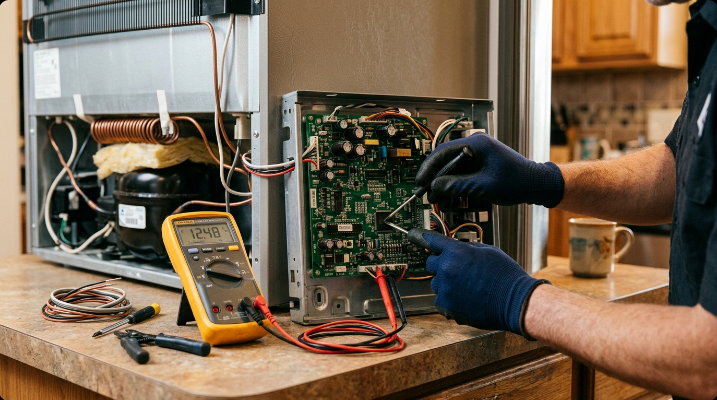
My refrigerator stopped making ice on a Sunday, which is exactly the kind of small domestic failure that shouldn’t matter and somehow does. I called an appliance repair technician on Monday, and by Wednesday I had a diagnosis: the main control board, the part that governs everything from the compressor cycle to the icemaker, had failed. The part alone was $410. Labor was another $220. My fridge was six years old and cost $1,300 new. I sat at my kitchen table doing math I never expected to do, and that’s when I actually went looking for what “right to repair” means in practice, instead of treating it as a headline I skim past.
The Diagnosis That Started This
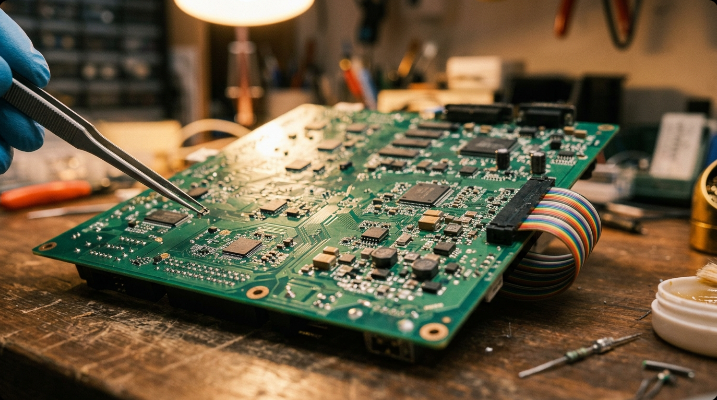
Here’s the part that actually made me angry, and it wasn’t the price. It was that the technician couldn’t just replace the failed component on the board. Modern control boards in mid-range and high-end refrigerators are sealed units, and in my model, the manufacturer only sells the entire board as one assembly, populated with parts that individually cost maybe thirty dollars. There’s no schematic available to independent repair shops for board-level diagnostics, no official parts catalog for the individual chips, and the firmware that runs the board is locked to prevent flashing a replacement or a refurbished unit without a manufacturer-paired serial number. My technician, who has fixed appliances for eighteen years, told me flatly that this wasn’t how it worked even five years ago. He used to repair boards like mine at the component level for sixty or seventy dollars in parts. Now he just orders the whole assembly and marks it up, because that’s the only option the manufacturer leaves him.
Why Appliance Repair Got This Complicated
The shift makes sense once you follow the incentives, even if I don’t love where they lead. Appliance manufacturers make meaningful margin on selling whole replacement assemblies rather than components, and locking firmware to serial-paired boards prevents a secondary market of refurbished or third-party parts from undercutting that margin. It also, not coincidentally, nudges a certain percentage of repair decisions toward “just buy a new one,” which is a better outcome for a manufacturer’s unit sales than it is for my wallet or, frankly, for a landfill. None of this is illegal. Until fairly recently, none of it was even regulated. It’s simply what happens when a company controls both the product and the only legitimate path to fixing it.


The Real Cost Comparison: Repair vs. Replace
I want to walk through the actual numbers, because “right to repair” often gets discussed abstractly and I think the math is where it gets real. Repairing my six-year-old fridge: $630 total, restoring a unit with, realistically, four to six more years of life in it. Replacing it: a comparable new model ran $1,150 to $1,400 depending on features, plus delivery and haul-away fees that added another $80 to $120. On pure dollars, repair won clearly. But the calculation manufacturers are betting on isn’t pure dollars. It’s inconvenience, urgency, and the fact that most people don’t call around for repair quotes when their fridge is warm and their food is spoiling. I got lucky in that my fridge stopped making ice, not cooling entirely, so I had time to actually think this through instead of panic-buying a replacement at a big-box store that weekend.
What I Learned Trying to Source the Part Myself
Before agreeing to the technician’s quote, I spent an evening trying to find the control board myself online, partly out of stubbornness and partly out of curiosity about whether right-to-repair laws had actually changed anything for kitchen appliances specifically. I found the part on three different appliance-parts sites, ranging from $340 to $460, meaning my technician’s markup wasn’t unreasonable by industry standards. What I didn’t find, anywhere, was a repair manual with board-level diagnostics, a schematic, or any documentation beyond “remove eight screws, unplug harness, replace assembly.” That’s not a repair guide. That’s a parts-swap instruction sheet, and it confirmed what my technician had already told me: for this specific component, on this specific model, there was no meaningful independent repair path. The right to buy the replacement part existed. The right to actually understand or fix what failed inside it did not.
The North American Right-to-Repair Patchwork
Here’s where the timing of my fridge dying turned out to be relevant. As of 2026, right-to-repair legislation has passed in a growing number of U.S. states, including New York, Minnesota, Colorado, California, and Oregon, with more states actively considering similar bills. But the laws that exist so far are aimed overwhelmingly at electronics and, in some states, agricultural and medical equipment, requiring manufacturers to make parts, tools, and documentation available to consumers and independent repair shops. Large kitchen appliances are only partially covered, and enforcement varies significantly by state and by product category. Minnesota’s law is broader than most and does reach some appliances, but a New York resident and a Minnesota resident with the identical broken refrigerator can have meaningfully different legal standing to demand repair documentation from the same manufacturer. Canada has moved more slowly at the federal level, with amendments to copyright law aimed at enabling repair-related circumvention passing in 2024, though practical enforcement and manufacturer compliance are still catching up. If you’re a North American consumer trying to exercise a “right to repair” your kitchen appliances, the honest answer in 2026 is that your actual rights depend heavily on your zip code, and most people have no idea which category their fridge, dishwasher, or oven falls into.
What Manufacturers Say vs. What I Experienced
Manufacturer trade groups have generally opposed broad right-to-repair mandates, arguing that locked firmware and proprietary diagnostics protect consumers from unsafe DIY repairs and protect the company’s warranty obligations from being complicated by third-party parts. I don’t think that argument is made in bad faith, exactly. There’s a real safety consideration in a component that touches refrigerant lines or high-voltage compressor circuits. But that argument doesn’t really explain why a control board that only touches low-voltage logic and a display panel needs to be sold exclusively as a single sealed assembly with locked firmware. The safety case covers maybe a third of what’s actually restricted. The rest looks a lot more like margin protection dressed up as a safety policy, and having lived through the actual repair process, I came away far more skeptical of the industry’s stated reasoning than I expected to be going in.
A Real Comparison: My Dishwasher vs. My Refrigerator
Two years before the fridge died, my dishwasher’s control panel failed in a similar way, and the experience was completely different. That manufacturer, a different brand from a company with a longer history of supporting independent repair, publishes full board-level schematics, sells individual components rather than only full assemblies, and doesn’t lock firmware to a paired serial number. My technician replaced a $22 relay in about twenty minutes, and the whole repair cost $95 including labor. Same category of failure, same general type of appliance, wildly different repair economics, entirely because of a corporate decision about how much of the internal design to expose. That comparison did more to convince me right-to-repair is a real, solvable problem than any advocacy article I’d read before this happened to me directly.

Questions I Now Ask Before Buying Any Major Appliance
- Does the manufacturer publish service manuals or schematics for this model line, or only parts-replacement instructions?
- Are individual components available, or only full sealed assemblies for common failure points like control boards?
- Is firmware locked to a paired serial number, and does the manufacturer disclose this anywhere before purchase?
- What does an independent repair technician in my area say about this specific brand’s repairability, based on actual jobs they’ve done?
- Does my state have right-to-repair coverage that applies to this appliance category, and does the manufacturer appear to comply with it?
That last question is one I genuinely did not know how to answer before this happened, and I suspect most shoppers don’t either. Repairability isn’t listed on the yellow EnergyGuide sticker next to the appliance in the store, even though, in dollar terms over the life of the product, it probably matters more than the efficiency rating does.
What I Do Differently Now
I ended up repairing the fridge rather than replacing it, mostly because the math favored it clearly enough that convenience didn’t win out. But I’ve changed how I shop for appliances since. I now spend twenty minutes before any major purchase searching the brand and model alongside terms like “control board replacement cost” and “repairability,” specifically looking for what independent technicians and repair forums say rather than trusting marketing copy about “durability” and “reliability,” which are marketing words, not repair commitments. I also started keeping a small file of repair receipts and part numbers for everything in my kitchen, on the theory that the next time something fails, I want to already know whether I’m dealing with a manufacturer that makes repair reasonable or one that’s betting I’ll just buy a replacement out of frustration.
Why This Fight Landed in My Kitchen, and Why It Matters
Right-to-repair started as a conversation about phones and laptops, and it’s easy to assume that fight is mostly settled or mostly irrelevant to daily life once you’re not thinking about consumer electronics specifically. My six-year-old refrigerator taught me otherwise. The same pattern of locked firmware, sealed assemblies, and restricted documentation that advocacy groups spent a decade fighting over in the smartphone industry has migrated quietly into the appliances sitting in nearly every North American kitchen, and most of us won’t notice until something breaks and we’re staring at a $630 repair bill for a part that should have cost sixty dollars. I don’t think every appliance failure is a conspiracy, and I don’t think every manufacturer is acting in bad faith. But I do think the difference between my dishwasher repair and my refrigerator repair was entirely a corporate choice, not a technical necessity, and that’s exactly the kind of choice that changes once enough customers start asking about it before they buy, not after something breaks on a Sunday.
