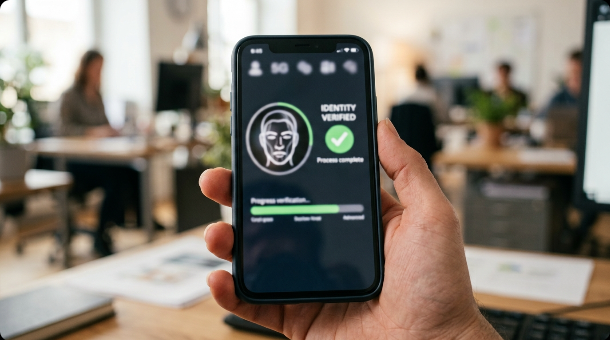
Over the course of a single month, I was asked to prove I was a real human being an unusual number of times, once by uploading a photo of a government identification card, once by recording a short video of my face turning slowly in a circle, once by solving a puzzle designed specifically to be difficult for automated systems. None of these requests came from the same company, and none of them felt connected to any specific incident I could point to. They simply arrived, one after another, as though some invisible industry-wide switch had been flipped all at once.
I do not think that impression is entirely wrong. Something has genuinely shifted in how digital platforms think about identity verification, and understanding why requires looking past any single app’s specific policy and toward a broader change in what the internet has quietly become over the past few years. The short version is that proving you are a real person has gotten harder, precisely because faking it has gotten so much easier.
The Technology That Broke the Old Assumptions
For most of the internet’s history, platforms operated on a reasonably safe assumption that a human being typing responses, uploading photos, and behaving with normal, slightly inconsistent human patterns was probably an actual human being. Fraud existed, but it existed at a scale and sophistication that older verification methods, a working email address, a phone number, a password, could mostly handle. That assumption has not held up well against a new generation of tools capable of generating convincing text, synthetic voices, and increasingly realistic fake images and video, all available cheaply and at genuinely massive scale.
This matters because the cost of creating a convincing fake account, a fake review, a fake customer service interaction, has collapsed dramatically, while the sophistication of that fakery has increased just as dramatically in the opposite direction. Platforms that once relied on the sheer tedium of manual fraud to keep bad actors to a manageable trickle now have to assume that trickle has become something closer to a flood, generated automatically, tirelessly, and at a volume no human fraud team could have produced a decade ago.


Why the Old Verification Methods Stopped Working
A password used to be a reasonable proxy for identity, something only the real account holder would know. That assumption has eroded steadily as data breaches exposed billions of passwords over the years, and as automated tools became capable of testing stolen credentials against new services at a scale no human attacker could manage alone. A phone number, similarly, used to imply a real person with a real carrier account behind it, until disposable virtual numbers made that assumption unreliable at scale.
What made older verification methods work was not really their inherent security. It was the friction and cost involved in faking them at scale. As that friction dropped toward zero for automated systems, while remaining exactly the same for ordinary human users, platforms were forced to search for new kinds of proof, ones that specifically exploit whatever remains stubbornly hard for automated systems to fake convincingly, at least for now. A face turning naturally in front of a camera, an identification document with specific physical security features, a puzzle requiring a kind of contextual reasoning that still trips up many automated systems.
The Uncomfortable Tradeoff Nobody Fully Explains
What bothers me about this shift is not that it is happening, since the underlying problem it responds to is genuinely real. What bothers me is how rarely platforms explain the actual tradeoff clearly, framing increasingly invasive verification requests as simple security improvements rather than acknowledging the genuine cost involved, namely handing over sensitive personal documents and biometric data to companies whose track record on protecting exactly that kind of information is, to put it generously, mixed.
Every time I upload an identification document or record a verification video, I am trusting that company’s entire security infrastructure, and every future security infrastructure it will ever have, to protect information that, unlike a password, I cannot simply change if it leaks. A compromised password is an inconvenience. A leaked scan of a government identification document, or biometric facial data, is a much harder problem to walk back, and that asymmetry rarely gets mentioned in the friendly, reassuring language these verification flows tend to use.
Who This System Actually Fails
Beyond the privacy tradeoff, these verification systems fail unevenly, and not always in obvious ways. People without easy access to government identification, people whose appearance has changed since their identification photo was taken, people using older devices with cameras that struggle to produce images clear enough for automated verification, all of these groups face real friction that more conventionally documented, well-equipped users simply never encounter. A system built to filter out automated fraud ends up, as a side effect, filtering out some of the exact real humans it was supposedly designed to let through.
I have not personally run into the more severe versions of this problem, but reading accounts from people who have made clear that verification failures are not evenly distributed, and that the burden of proving you are human falls hardest on people who already face other forms of friction navigating digital systems. That unevenness deserves more attention than it usually gets in discussions that treat identity verification as a purely neutral technical fix.
What I Have Started Doing Differently
I have not stopped using services that require this kind of verification, because in most cases the alternative is simply not participating in services that have become genuinely necessary for ordinary life. What I have started doing is being more deliberate about which verification requests I actually complete, questioning whether a given service genuinely needs government identification for what I am trying to do, or whether it is applying a blanket policy that could reasonably be satisfied with something less sensitive.
I have also started paying closer attention to how a company describes what happens to verification data after the process completes, whether it is deleted, how long it is retained, and whether it gets shared with third-party verification vendors I never directly agreed to trust. None of this fully solves the underlying tension between fraud prevention and personal privacy, a tension that is only going to intensify as the tools for faking human identity keep improving. But understanding why this shift happened, rather than treating each new verification request as an isolated annoyance, has at least let me make more informed choices about which of these tradeoffs I am actually willing to accept.
The Arms Race Nature of This Problem
What makes this particularly frustrating to think about is the arms race dynamic underlying the whole system. Every new verification method, however clever, becomes a target the moment it proves effective, and the same tools capable of generating convincing fake content are also capable, eventually, of learning to defeat whatever specific verification check currently stands in their way. The face-turning video requirement that feels reasonably secure today will likely feel quaint within a few years, replaced by something else that is, for a while, harder to fake, until it too gets targeted specifically because it works.
This means the current wave of verification requests is not really a stable endpoint. It is a snapshot of an ongoing race that shows no sign of concluding, and it strongly suggests that whatever mild inconvenience I am experiencing now with today’s verification flows is likely to be replaced by some new, probably more invasive, form of proof in the coming years, as the automated systems on the other side of this contest keep improving at roughly the same pace as the defenses built against them.
The Trust Companies Are Quietly Asking For
Underneath the technical mechanics, what these systems really ask for is a specific kind of trust that most users have never been asked to extend before, trust that a company’s internal security, vendor relationships, and long-term data retention practices will hold up not just today, but for years or decades into the future, covering information that cannot be reset or replaced the way a compromised password can. That is a much larger ask than the verification flows themselves ever acknowledge, framed instead as a quick, minor step standing between the user and whatever they actually wanted to accomplish.
I do not think most people fully register the size of that ask in the moment, myself included until I started paying closer attention. The verification screen is designed, understandably from the company’s perspective, to feel as frictionless and reassuring as possible, which means the actual scope of what is being requested tends to get minimized rather than explained. Recognizing that gap has changed how carefully I read the fine print before completing one of these flows, even when the underlying fraud-prevention goal is one I genuinely support.
A Few Questions Worth Asking Before You Verify
Since I cannot avoid these requests entirely, I have settled on a small set of questions I now ask myself before completing one. Does the specific service genuinely need this level of verification for what I am trying to do, or does the request feel disproportionate to the actual risk involved. Is there a less invasive alternative available, even if it takes a few extra steps to find in the settings. And does the company’s stated data retention policy, when I can actually find it, describe what happens to my information after verification in language specific enough to trust, rather than vague reassurance.
None of these questions eliminate the underlying tradeoff, and I still end up completing plenty of these flows simply because the service in question has become genuinely necessary for something in my life. But asking them deliberately, rather than clicking through on autopilot the way I used to, has at least made me a more informed participant in a system I suspect none of us fully chose, but that all of us are now living inside, one verification request at a time.
