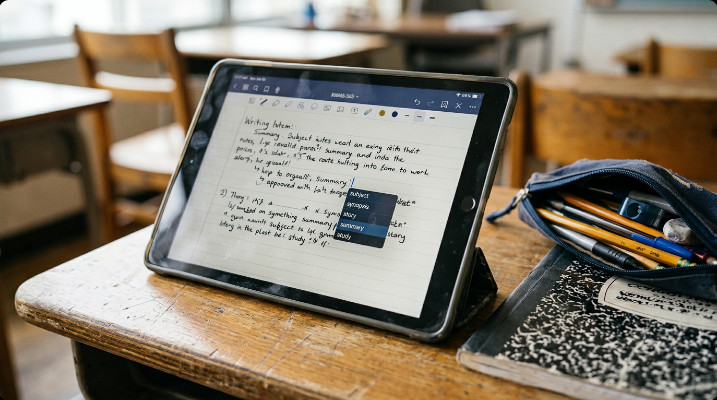
I noticed it while reading over my older kid’s shoulder during a homework session: three different sentences in a row started with the exact phrase the autocomplete suggestion had offered, phrases my kid wouldn’t normally reach for unprompted. Not wrong exactly, just noticeably not their usual voice. That was the moment I actually started paying attention to how much of the family’s writing tools now finish sentences before anyone finishes thinking them, and what that might mean for how my kids are learning to write in the first place.
What I Actually Observed, Not What I Assumed
I want to be careful here to describe only what I directly saw, not draw conclusions about anything I can’t actually measure. What I saw was a specific, repeatable pattern: when autocomplete suggestions were on, my older kid’s essays leaned toward longer, more formal-sounding sentences with vocabulary that didn’t match how they talk out loud. When I turned suggestions off for a week of homework, the writing got shorter, a little rougher around the edges, and distinctly more like how that kid actually speaks. I’m not a researcher and this isn’t a controlled study of my own children. It’s just a pattern I could see plainly once I started looking for it.



The Specific Habit That Concerned Me
The behavior that actually worried me wasn’t the vocabulary shift, some vocabulary growth from exposure to more sophisticated phrasing seems like a reasonable, even positive thing. It was watching my kid pause mid-sentence, wait for a suggestion to appear, and then choose from what was offered rather than generating the next word independently. That’s a different writing behavior than editing your own draft, it’s closer to selecting from a menu, and it happened often enough during a single essay that it looked less like an occasional shortcut and more like a default way of composing sentences.
A Direct Comparison: Same Assignment, Suggestions On and Off
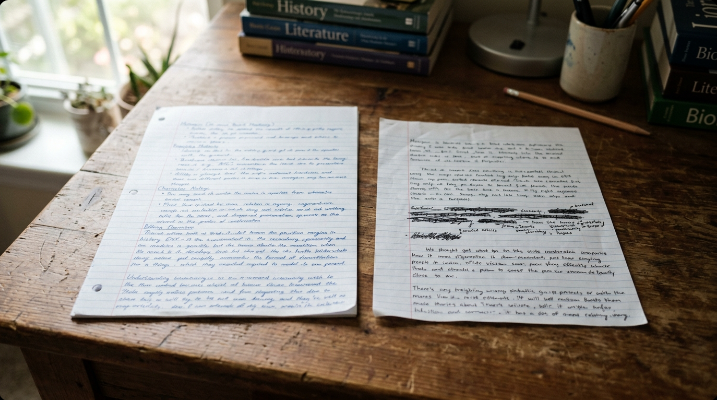
I got the clearest look at this by having my kid write two similar short assignments a week apart, one with autocomplete suggestions active and one with them switched off entirely. With suggestions on, the essay took about twelve minutes and read smoothly but somewhat generically, several sentence openings sounded like phrases I recognized from the suggestion patterns rather than my kid’s usual phrasing. With suggestions off, the same assignment took closer to twenty minutes, included two crossed-out false starts, and read distinctly more like something that specific kid would actually say out loud. The slower version took longer. It was also, unmistakably, theirs.
What Existing Research on Writing Tools Suggests
This tracks with a pattern that educators and writing researchers have flagged as autocomplete and predictive text tools have become more common in schools: composing with heavy suggestion assistance changes the physical and cognitive process of writing, shifting it from generation toward selection, and some studies on student writing with and without predictive tools have found measurable differences in sentence originality and structural variety between the two conditions. Researchers studying this are still working out what it means for the development of independent writing skill over time, and I want to be honest that the long-term picture isn’t settled science yet, it’s an active and reasonable area of ongoing study rather than a resolved question.
Where I Think the Tools Are Genuinely Useful
I don’t want to overstate this into a case against the technology entirely, because there are real, specific uses where it helped rather than hurt. For a research report where the content mattered more than voice, or for a kid working through a topic they found genuinely difficult to phrase, autocomplete suggestions reduced frustration and kept them engaged with finishing the assignment rather than getting stuck. The distinction that mattered in our house wasn’t suggestions versus no suggestions categorically. It was which specific writing tasks benefited from the assist and which ones seemed to lose something meaningful when the sentence got finished by a suggestion instead of by my kid.
The Household Rule We Settled On
What we landed on, as a family decision rather than a rule I imposed unilaterally, was turning off predictive suggestions for personal writing, journal entries, creative stories, anything where voice was the actual point, while leaving them on for factual homework where getting information down clearly mattered more than style. My kids helped decide where that line went, which mattered to me, because the goal wasn’t controlling their writing process from outside, it was helping them notice a distinction they hadn’t had a reason to think about before.
What I’m Still Watching For
I’m deliberately not treating this as a solved problem. I check back in every few months by having each kid write something short with suggestions off, just to see whether their independent, unprompted writing still sounds like them, still has the small rough edges and specific word choices that make it recognizably theirs rather than smoothed toward whatever the tool tends to suggest. So far it still does. That’s the specific, concrete thing I’m actually watching, not some broader worry about technology and childhood in the abstract, just whether the writing on the page still sounds like the kid who wrote it.
The Teacher Conference That Confirmed My Suspicion
A parent-teacher conference last spring gave me independent confirmation of something I’d only suspected at home. The teacher mentioned, unprompted, that she’d noticed a shift across several students’ writing over the past couple of years: essays that started strong with a clear, distinctive voice in the opening sentence or two and then flattened into more generic, evenly paced prose by the middle paragraphs. She hadn’t connected it to autocomplete specifically until I mentioned what I’d been noticing at home, but the pattern she described matched almost exactly.
Her working theory, which she was careful to frame as an impression rather than a formal finding, was that kids write the opening of an assignment with real intention, then start accepting suggested continuations more readily as they tire partway through, especially on longer assignments completed late in the evening. The suggestions aren’t wrong exactly. They’re just averaged, built to be plausible for a general case rather than specific to what a particular child was actually trying to say. Over a full essay, that averaging effect compounds, and the result reads like it drifts from one voice into a smoother, more generic one partway through.
That conversation mattered to me because it moved the concern out of my own household and confirmed it wasn’t just a pattern I was imagining. It also gave me a more precise thing to watch for: not whether the writing looked polished, but whether it stayed consistent in voice from beginning to end.
What Changed When We Turned Suggestions Off for a Month
We ran a simple household test: predictive suggestions off for all schoolwork for one full month, typing assistance limited to basic spell-check only. The first week produced visibly rougher drafts, more crossed-out words, more time spent staring at the screen between sentences, exactly what you’d expect when a scaffold is suddenly removed. By the third week, something more interesting happened: the sentences got longer and more specific again, closer to the distinctive voice from those strong opening paragraphs the teacher had described, sustained across an entire piece rather than just the first few lines.
We didn’t run this as a rigorous study, and a single household’s month-long experiment proves very little on its own. But the pattern was consistent enough across several different assignments that it changed how we think about the tools day to day. The suggestions aren’t harmful in short bursts. The concern is really about default, constant use over months and years, during exactly the period when a child’s own sentence-level instincts are still being built. Removing the scaffold occasionally, deliberately, seems to give those instincts room to keep developing rather than quietly outsourcing them.
How We Talked About This With Our Kids Directly
One thing we changed partway through was including our children in the conversation instead of just quietly adjusting settings behind the scenes. We explained, in simple terms appropriate to their ages, that the suggested words on the screen come from a pattern of what other people usually write, not from their own thinking, and that leaning on those suggestions too often could mean their own writing voice gets a little quieter over time. Framed that way, as a question of keeping their own voice rather than a rule about screen time or technology being bad, the conversation landed better than any of our previous, vaguer attempts to explain the concern.
They didn’t love giving up the suggestions at first, understandably, since the tool genuinely does make typing faster and less effortful in the moment. But naming the trade-off explicitly, faster typing now versus a stronger, more distinctive voice later, gave them a reason to buy into the household rule that wasn’t just “because we said so.” We’ve found that kind of explanation tends to hold up better over months than a rule enforced without a reason attached, and it’s made the whole approach feel less like restriction and more like a shared decision about a specific tool.
We also checked in with our pediatrician about it during a routine visit, more out of curiosity than concern, and got a reasonable, measured answer: there’s no established clinical guidance yet specific to predictive text and developing writing skills, since the tools are too new for long-term research to exist. The advice was general and familiar, balance, variety, and paying attention to how a child responds rather than following a fixed rule, which is roughly where we’d already landed on our own.
What This Actually Taught Me as a Parent
The real lesson wasn’t that autocomplete is good or bad for kids in some general sense, I don’t think the evidence supports a confident claim that broad either way. It was that a tool quietly built into every writing surface my kids use had started shaping their sentences in ways neither they nor I had consciously decided on, and it took actually reading closely, not assuming, to notice it happening at all. Paying that kind of specific attention, rather than trusting the tool by default or rejecting it by default, is the habit I actually want to model for them going forward.
