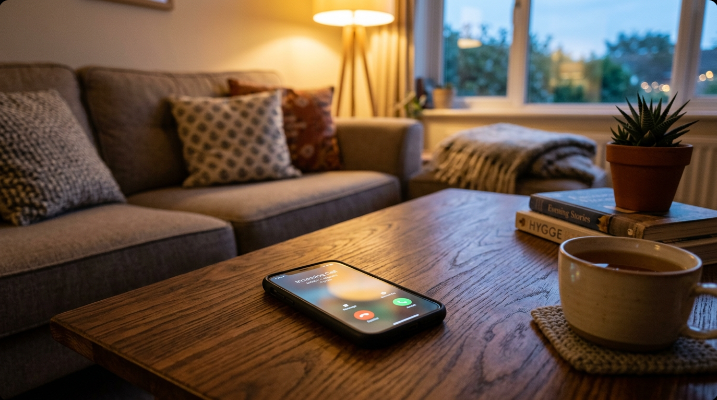
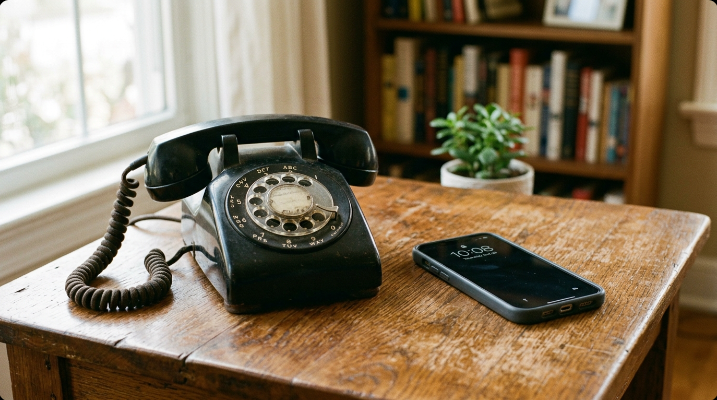
My mother called me three times last Tuesday before I finally picked up, and my first reaction wasn’t concern that something was wrong. It was mild irritation, the specific modern irritation of an unscheduled phone call landing in the middle of a text-based day. I called her back within the hour and asked, half-joking, why she hadn’t just texted. She said something that stuck with me: “I did text you. Two days ago. You never text back either.” She was right on both counts, and standing in my kitchen holding a phone I use constantly for everything except its original purpose, I realized I’d become one of those people I used to find slightly baffling: someone who treats an incoming call, from anyone, as an interruption rather than a connection.
The Moment I Noticed My Own Avoidance
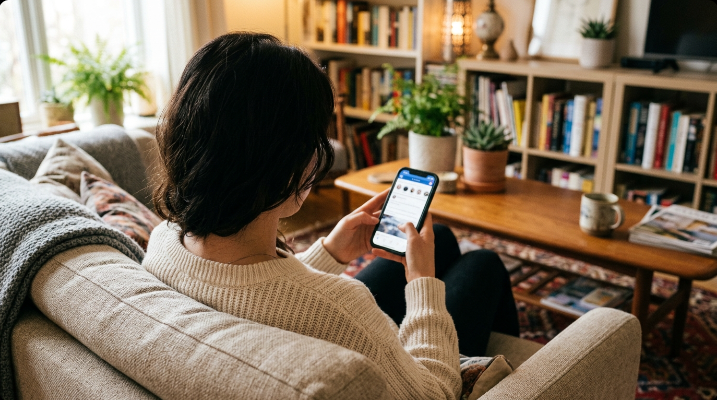
I started paying attention to my own behavior after that call, and the pattern was uncomfortable to see clearly. Over one week, I received eleven phone calls. I answered three live. The rest I let go to voicemail, checked who it was, and texted back “sorry, in a meeting, what’s up?” regardless of whether I was actually in a meeting. I wasn’t avoiding these people. I like my mother, my closest friends, my dentist’s office. I was avoiding the format itself, the unstructured, real-time, no-preview nature of a ringing phone, in favor of something I could read, process, and respond to on my own schedule. That’s not laziness exactly. It’s a preference I’d built without ever consciously choosing it.
Why the Phone Call Started Feeling Like an Imposition
A phone call demands something a text doesn’t: your full, immediate, synchronous attention, plus a socially acceptable amount of small talk before you can get to the point. A text lets you skip straight to the point, respond in six words, and pick the conversation back up four hours later without either party feeling slighted. Once you’ve spent years communicating in a format that respects your schedule, a format that doesn’t has to actively justify itself. An unscheduled call now implicitly says “my need to talk to you right now outweighs whatever you’re doing,” which used to be an unremarkable assumption and now reads, to a lot of people my age, as faintly presumptuous. I don’t think that’s a virtue. I think it’s a habit that calcified into an assumption, and once I named it, I didn’t love what it said about how I was treating people who cared enough to actually call.
The Data Behind the Feeling
This isn’t just my personal quirk. Multiple carrier and market research surveys over the past several years have found that adults under 40 in the US and Canada let a large majority of incoming calls from unsaved or even saved-but-non-urgent numbers go to voicemail, and a significant share of younger adults report actively feeling anxious when a phone rings unexpectedly, a phenomenon that’s been informally labeled “telephone anxiety” in enough research and journalism now that it’s stopped being a niche observation. Voicemail-to-text transcription usage has climbed specifically because people don’t want to listen to a voicemail; they want to read a summary of one, which is a small but telling detail about how thoroughly text has become the default even for messages that arrived as speech.
What Actually Gets Lost in a Text Thread
I noticed the real cost of this shift only when I compared how a difficult conversation with my sister went by text versus how the same conversation went, a year earlier, by phone. By text, small disagreements took days to resolve because tone is genuinely ambiguous in writing, and both of us reread short messages looking for implied meaning that usually wasn’t there. On the phone, the same disagreement resolved in twenty minutes, because you can hear hesitation, warmth, or frustration immediately and respond to the actual emotional content instead of guessing at it from word choice and punctuation. Texting is efficient for logistics. It is a genuinely worse tool for anything with emotional weight, and I think a lot of unresolved tension between people who talk constantly by text traces back to exactly this gap.
A Real Comparison: My Two Closest Relationships
I have two relationships that make this contrast obvious. With my college roommate, we talk by phone almost every week, thirty to forty minutes, no particular agenda. With a coworker turned friend, we’ve exchanged probably ten thousand text messages over three years and spoken by phone maybe four times total. The roommate relationship feels, to me, meaningfully deeper despite objectively less total communication time, and I think it’s specifically because phone calls force a kind of unstructured, associative conversation that text doesn’t produce. You ramble on a call. You follow tangents. Texting is almost always purposeful, which is efficient and also, I’ve come to think, a little bit impoverished as a way of actually knowing someone over time.
Why Businesses Feel This Shift Too
It’s not just personal relationships. I run a small side project selling handmade goods online, and I switched my customer service line to text-first two years ago after noticing that phone inquiries had dropped by more than half while message-based inquiries through my site and social accounts had tripled. Customers, especially ones under about 35, will type out a fairly detailed question to a business before they’ll call it, even when calling would resolve the issue faster. I don’t think this is customers being difficult. I think it reflects the same avoidance I catch in myself: a call requires committing to a live conversation with an unknown wait time and an unknown person on the other end, while a text can be sent from a checkout line and answered whenever.
The Generational Split Is Real, But It’s Not Clean
It would be tidy to say this is purely a young-versus-old divide, but my own experience complicates that. My father, in his seventies, now prefers text for anything routine and only calls for things he considers actually important, which is its own kind of adaptation, not resistance to it. Meanwhile I know people in their twenties who still call their close friends constantly and find text-only friendships slightly cold. The real divide isn’t age. It’s how much of a given relationship was built during a period when calling was the default versus a period when it wasn’t, which is why calling still feels natural with my roommate from a pre-smartphone era of our friendship and feels almost intrusive with people I met after texting had already won.
What I Changed After Noticing This
I didn’t overhaul my habits dramatically, but I made two specific changes. First, I started actually answering calls from a small list of people, unconditionally, regardless of what I’m doing, because I decided the two minutes of interruption is worth not making them feel like a burden for wanting to talk to me. Second, when I have something with real emotional weight to discuss, a disagreement, bad news, anything where tone matters, I now default to calling instead of texting, even though every instinct still nudges me toward the keyboard. It feels slightly effortful in a way it didn’t used to, which is itself evidence of how thoroughly the default has shifted.
What Happened When I Forced Myself to Call Back
Two months ago I set myself a small, deliberately uncomfortable rule: any time someone left me a voicemail, I would call them back instead of texting a reply. No exceptions, not even for people I mostly text anyway. The first few calls felt stilted in a way that embarrassed me a little, like I’d forgotten a basic social skill I used to have on autopilot. I fumbled the opening seconds, unsure whether to explain why I was calling instead of texting, unsure whether the other person would even want to talk.
Almost every single time, the call ran long. A question that would have taken three text exchanges over twenty minutes got resolved in ninety seconds, and then neither of us hung up. We kept talking. My sister and I ended up on the phone for forty minutes over something that started as a scheduling question about our mother’s birthday. None of that extra time was necessary in any practical sense. It happened because voice removes the natural stopping point that a text thread has built into it; there’s no obvious place to just stop typing when you’re actually mid-conversation with someone’s actual voice.
What struck me most was how much information came through that a text simply can’t carry. My sister’s voice had a tightness in it that told me something was bothering her before she said a word about it, and if she’d texted me the same update I would have read it as neutral, maybe even upbeat. I would have missed it completely. That’s the layer I think we’re quietly giving up every time we default to text: not the content of what’s said, but the tone underneath it, which often carries the more important message.
I haven’t kept up the habit perfectly. Some weeks I slide back into texting everyone because it’s faster and I’m tired. But the experiment left me with a genuine appreciation for what a two-minute phone call does that forty text messages can’t, and a small amount of guilt about how rarely I choose it.
There’s also a small practical case for calling that gets overlooked in this whole debate: it’s simply faster for anything with more than two or three decision points. Coordinating a group dinner over text can eat up an entire afternoon of scattered replies, while the same coordination over a single phone call to one organizer takes five minutes. We’ve somehow decided that the slower method is the polite default, and the faster one is the intrusive outlier.
What We Actually Lost, and What We Didn’t
I don’t think the shift away from phone calls is a tragedy, and I’m suspicious of nostalgia that treats every new communication habit as decline. Texting is genuinely better for logistics, for low-stakes updates, for reaching people across time zones without demanding synchronous attention nobody has to spare. But my mother calling three times and me feeling irritated instead of glad is a small, honest data point about something that did erode: the assumption that a person wanting to talk to you, in real time, with their actual voice, is a gift rather than an imposition. I’ve started trying to answer more like that’s still true, because on the one call a week I actually take unscheduled, it usually still is.
