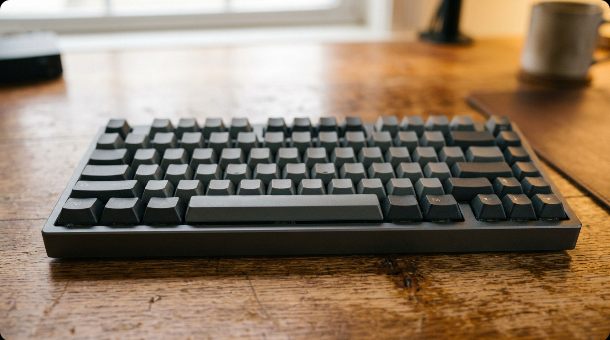
I spent almost ten years typing everything important on a piece of flat glass. Emails, work reports, late-night messages to friends, the occasional short story I never finished. Somewhere along the way I stopped noticing that I was doing it, the way you stop noticing a hum in the background of a room until someone points it out. It took a broken laptop hinge and a borrowed mechanical keyboard to make me notice again, and once I noticed, I could not unnotice it.
This is not a story about nostalgia for typewriters, and it is not a rant against touchscreens, which genuinely are remarkable pieces of technology. It is a story about a slow, almost accidental experiment that changed how I write, how fast I think, and honestly how tired my hands feel at the end of a long day. I did not expect a keyboard to matter this much. I was wrong, and I want to walk through exactly how I found that out.
The Decade I Did Not Think About Typing At All
For most of the last ten years, typing was something that happened to me rather than something I did on purpose. Phones got bigger, tablets got thinner, laptops got lighter, and every device I owned nudged me toward the same flat, borderless surface. Predictive text filled in the gaps. Autocorrect fixed the mistakes I did not even know I was making. It felt efficient in the moment, and in a narrow sense it was.
What I did not track, because nobody tracks this kind of thing casually, was how much of my typing had quietly become thumb typing. Short bursts. Fragments. Messages composed in the time it takes to wait for a coffee order. Longer writing, the kind that requires sustained thought over several paragraphs, had almost disappeared from my daily habits without me deciding it should. I had simply stopped doing the kind of writing that a touchscreen makes tedious, and I had not noticed the substitution happening.
It is worth saying clearly that this was not really the touchscreen’s fault. A touchscreen is a general tool that happens to be excellent at some things and mediocre at others. The problem was that I had let it become my only tool, and I had let my writing habits shrink to fit whatever that tool made easy.
The Borrowed Keyboard That Started Everything
The actual turning point was mundane. My laptop’s hinge started grinding, then catching, then refusing to open past a certain angle. While it sat at a repair shop, a coworker lent me an old mechanical keyboard that had been living under his desk for years, plugged into a secondary monitor setup he barely used. I hooked it up to my desktop mostly out of necessity, expecting nothing more than a functional stopgap.
The first thing I noticed was the sound. Not loud exactly, but present, a rhythm under my hands that gave every keystroke a kind of confirmation I had not realized I was missing. The second thing I noticed, within the first hour, was that I was typing faster and, more importantly, typing longer. A single email turned into three paragraphs instead of one. A quick note to myself turned into an actual outline. Nothing about the content changed on purpose. Something about the friction changed, and the friction had apparently been doing more work than I gave it credit for.
I do not think this is unique to me, and it is not really about mechanical keyboards specifically, though those get most of the attention online. It is about physical feedback, about keys that have travel and resistance and a defined endpoint, compared to a surface that gives you nothing back except a visual flicker and maybe a small vibration if you have haptics turned on.
What Actually Changes When You Have Real Keys
Touch typing depends on your fingers knowing where they are without your eyes confirming it. On a physical keyboard, the small bumps on the F and J keys, the slight dish in the keycaps, the resistance of each press, all give your hands a constant stream of information that lets them work independently of your eyes. On a flat touchscreen, that information mostly disappears. Your eyes have to do the job your fingers used to do, which means more glancing down, more micro-corrections, and more of your attention pulled away from the actual sentence you are trying to write.
I noticed this most clearly when I tried to type without looking at either keyboard, just to compare. On the physical keyboard, I got through a full paragraph with only a couple of errors, correcting them by feel before I even saw them. On the touchscreen, without visual confirmation, I barely made it past a sentence before the words dissolved into nonsense. That gap surprised me, mostly because I had genuinely believed I had adapted to touch typing on glass. I had not. I had adapted to typing while looking, which is a different and more exhausting skill than I realized.
There is also the matter of actual physical comfort, which nobody warns you about until your hands start complaining. Typing on a flat surface for long stretches means your fingers are absorbing every keystroke’s impact directly into unforgiving glass, with your wrists often bent at an angle that a proper keyboard and a bit of ergonomic awareness would never allow. After a few weeks back on a keyboard with actual key travel, the mild soreness I had started to consider normal in my fingertips simply went away. I had assumed that ache was just part of typing a lot. It was not. It was part of typing a lot on the wrong surface.
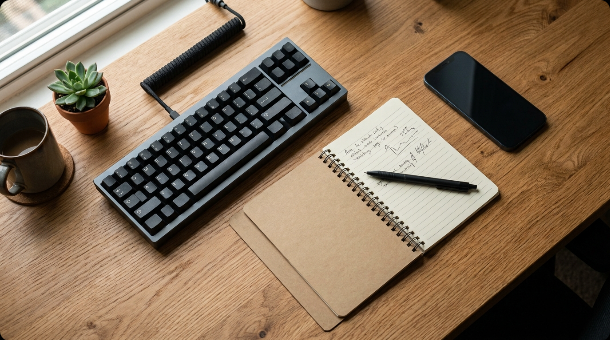
The Focus Difference Nobody Warned Me About
The part I did not expect at all was how much a physical keyboard changed my relationship with distraction. A touchscreen keyboard lives on the same device as everything else, the same glass that shows notifications, the same glass I can swipe away from mid-sentence to check something that almost certainly did not need checking. Typing and getting distracted happen on the identical surface, which makes the transition between them essentially frictionless.
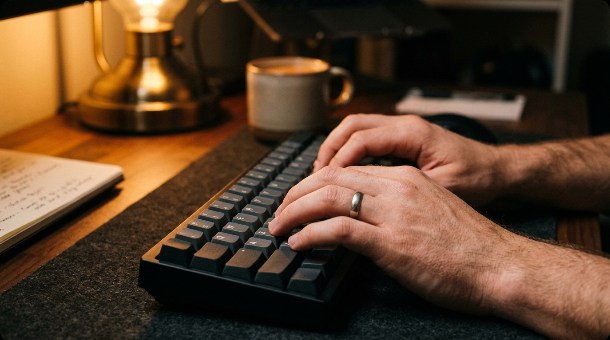
A physical keyboard, especially one connected to a desktop setup I use specifically for focused work, created an actual boundary. Sitting down at that keyboard became a small ritual that signaled to my own brain that this was writing time, not scrolling time. It sounds almost too simple to matter, but the separation of tools turned out to be doing quiet psychological work I had not accounted for. My phone stayed a phone. My keyboard became a place where longer thoughts happened.
I want to be careful not to oversell this. A keyboard did not fix my attention span or turn me into someone who writes for six uninterrupted hours. What it did was lower the activation energy required to start writing something longer than two sentences, and it turned out that activation energy had been the real obstacle the whole time, not any lack of ideas or time.
Where Touchscreens Still Win, and I Am Not Pretending Otherwise
None of this means I think touchscreens are bad or that everyone should rush out and buy a keyboard. For quick replies, for browsing, for anything visual like editing photos or navigating a map, a touchscreen is still the better tool, often by a wide margin. My phone remains a touchscreen, and I have no plans to change that. The keyboard debate only really matters for the specific task of sustained writing, and even then only for people who do enough of it to notice the difference.
I also want to be honest that some of what I felt was probably novelty. A new tool, even an old-fashioned one, can feel exciting simply because it is different from what you were doing before. I gave myself a few months before writing any of this down, specifically to see whether the effect would fade once the novelty wore off. It did not fade. If anything, the difference became more obvious as the initial excitement wore away and I was left with just the practical experience of writing on two different surfaces, week after week, with nothing left to prove to myself either way.
What I Would Actually Tell Someone Considering This
If you write occasionally and your current setup feels fine, there is genuinely no reason to change anything based on my experience. Not every habit needs fixing, and plenty of people type comfortably and productively on glass every single day. But if you notice, the way I eventually did, that your longer writing has quietly shrunk down to fragments and quick replies, it might be worth asking whether the tool is shaping the habit rather than the other way around.
You do not need an expensive mechanical keyboard to test this. Any basic keyboard with real key travel, connected to whatever device you already own, is enough to notice whether the friction I am describing applies to you too. Give it a couple of weeks before deciding. The first few days will probably feel slower, almost regressive, because your hands have to relearn a kind of independence they have not needed in years. That slowness is not a sign it is not working. In my case, it was the exact opposite.
Ten years of touchscreens taught me to type fast in short bursts and taught my hands to stop trusting themselves without constant visual confirmation. A few months back on a real keyboard undid more of that than I expected, and reminded me that the tools we use every single day, the ones that feel too basic to question, are sometimes exactly the ones worth questioning.
A Small Test I Ran on Myself
Curious whether I was fooling myself, I tried a rough experiment. For two weeks I wrote my daily notes exclusively on the touchscreen, timing how long it took to produce roughly three hundred words of actual coherent writing, not messages, not fragments, but something closer to a short journal entry. Then I switched to the physical keyboard for the following two weeks and repeated the same exercise at the same time of day. I was not trying to run a scientific study, just trying to get an honest read on my own habits rather than trust a vague feeling.
The touchscreen weeks averaged close to twenty minutes for those three hundred words, and a good chunk of that time was spent correcting autocorrect changes I had not wanted, or backing up to fix a sentence that had wandered off track while I was distracted mid-thought. The keyboard weeks averaged closer to twelve minutes, with noticeably fewer corrections and, subjectively, entries that felt more like a continuous line of thought rather than a series of stitched-together fragments. I do not think those numbers would hold up as rigorous data. But they matched what my hands had already been telling me, and that was enough to convince me the difference was real rather than imagined.
The Setup That Finally Stuck
I did not end up rebuilding my entire life around a mechanical keyboard, and I want to be clear about that because it would be an exaggeration to suggest otherwise. What actually stuck was a simple, boring setup: a basic keyboard with decent key travel sitting next to my usual devices, reserved specifically for anything longer than a few sentences. Quick replies still happen on glass. Actual writing happens on keys. That division, once I stopped overthinking it, turned out to be the whole solution.
What surprised me most, looking back over the past several months, is how little willpower the change actually required once the keyboard was simply sitting there. I did not have to convince myself to use it every time. Having the right tool within reach did most of the convincing on its own, which is probably the most honest lesson in all of this: habits shift more easily when you change what is physically in front of you than when you rely on remembering to do things differently.
