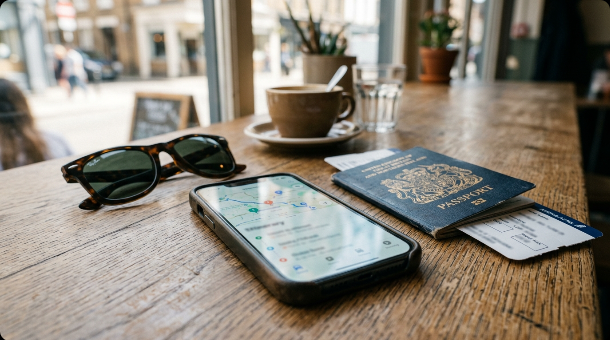
I’ve planned every family trip for twelve years, and I’ve gotten good at it in the way you get good at anything you do out of necessity: efficiently, joylessly, and always slightly over budget. So when my sister suggested I just let an AI chatbot plan our anniversary trip this year, I said yes mostly out of exhaustion. I typed in our dates, our budget, the fact that my husband hates crowds and I hate flights longer than five hours, and asked it to give me a full itinerary. What came back wasn’t the trip I expected, and that’s the part I can’t stop thinking about.
What I Actually Asked For
I was specific, because I’ve learned that vague prompts get vague answers. I gave it our travel dates, a hard budget ceiling, and a list of constraints: no red-eye flights, at least one full rest day, a destination reachable without a layover longer than ninety minutes, and something neither of us had done before. I also told it we usually default to beach towns because that’s what feels safe to plan, and asked it to push back on that instinct if it had a better idea.
It suggested a lake town I’d genuinely never heard of, four hours from a major airport, with a shoulder-season rate that undercut every beach option I’d already bookmarked. My first reaction was skepticism. My second was to open eleven tabs to verify everything it told me, because I did not trust a chatbot with my anniversary.



The Research I Didn’t Expect to Do
Here’s the part nobody warns you about: using AI to plan a trip doesn’t remove the research, it relocates it. I spent almost as much time fact-checking the itinerary as I would have spent building one from scratch. Restaurant hours were sometimes stale. One recommended trail had been closed for erosion repair since spring, information the model clearly hadn’t seen. A “10-minute walk” between two stops turned out to be closer to thirty when I checked an actual map.
What it was genuinely good at was the part I’m worst at: surfacing options I wouldn’t have thought to search for in the first place. I don’t know the right questions to ask about a town I’ve never heard of, so I never would have found the lake town on my own, because I wouldn’t have known to look. The AI wasn’t smarter than me at travel planning. It was just unburdened by my habits, which turned out to be its own kind of useful.
By the third round of back-and-forth, I’d stopped asking it for a finished itinerary and started asking it for options at each decision point instead, then verifying and choosing myself. That shift changed the whole experience. It stopped feeling like outsourcing and started feeling like having a very well-read friend who’d never actually been anywhere.
Where It Actually Helped
The genuine value showed up in three places. First, in breaking my own defaults: I always pick beach towns, and having something else suggested with real reasoning behind it (shoulder season pricing, fewer crowds, a specific trail we’d both enjoy) was enough to get me to actually consider it instead of scrolling past. Second, in the tedious cross-referencing work of matching flight times to hotel check-in windows to restaurant closures, which is exactly the kind of multi-variable logistics I usually get wrong at 11 p.m. while overtired. Third, in giving me a rough first draft to react to, which turned out to be much easier than building a plan from a blank page. Reacting to something wrong is faster than generating something right.
Where it fell short was anything time-sensitive or hyper-local: closures, current pricing, whether a specific trail was still accessible, whether a restaurant had actually survived the last two years. Anything that required knowing what was true this week rather than what was generally true, it got wrong at least once. I’d budget in real verification time for anyone trying this, not just a skim.

What I’d Actually Do Differently Next Time
I’d use it earlier and trust it less. Earlier, because the real value was in the first round of ideas, the possibility I hadn’t considered, not in the finished itinerary. Less, because every specific claim about hours, prices, or current conditions needs a human check before it goes anywhere near a booking. I’d also be more specific about what I actually value on a trip, not just logistics but mood: I want unstructured time, not a schedule packed hour to hour, and it took me two follow-up prompts to get it to stop over-planning our days.
The trip itself turned out well. We went to the lake town. The trail closure meant we rerouted to a shorter one that turned out to be quieter and, if I’m honest, prettier. My husband still doesn’t fully believe an algorithm picked it, and keeps calling it “your AI thing” like it’s a slightly embarrassing hobby. Maybe it is. But it’s the first vacation in years I didn’t spend three exhausted weekends building from scratch, and next time I’m starting with it again, just with my eyes more open about which parts of the plan to trust.
The Trust Problem Nobody Talks About
What surprised me most wasn’t the itinerary itself, it was how much energy I spent deciding how much to trust it. There’s no established etiquette yet for this. With a human travel agent, I know roughly how much to double-check: I trust their flight logistics, I verify anything involving my own preferences. With a search engine, I know the results are links I still have to evaluate myself. A chatbot sits in an uncomfortable middle ground, phrased with the same confidence whether it’s right or wrong, and I found myself instinctively trusting the parts that were stated with more detail, which turned out to be a bad instinct. The trail closure was described just as specifically and confidently as the parts that were accurate.
I ended up building my own rough rule by the end of the process: trust it for ideas and structure, verify anything with a date attached to it. Prices change, hours change, closures happen, and none of that is really the model’s fault, it’s a snapshot of information that was true at some point and is presented as if it’s true right now. Once I started treating every specific claim as “probably true as of some unknown recent date” instead of “true,” the whole exercise got a lot less stressful and a lot more useful.
How This Changed My Approach to Other Planning
Since the trip, I’ve started using the same rough process for other things I used to dread starting from scratch: birthday party logistics, a kitchen renovation shortlist, even meal planning for a week when I’m too tired to think about it. The pattern that keeps repeating is the same one from the vacation. AI is genuinely useful for breaking the blank page, for surfacing an option I wouldn’t have thought to search for, and for handling the tedious cross-referencing between constraints. It is not useful, at least not yet, for anything where being current matters more than being plausible.
I’ve also gotten faster at the follow-up questions that actually improve the output. Asking for three distinct options instead of one finished plan. Asking it to explain its reasoning, which makes it much easier to spot when a suggestion is based on something generic rather than my actual constraints. Asking what it’s uncertain about, which sometimes surfaces caveats it wouldn’t have volunteered on its own. None of this makes it infallible. It just makes the back-and-forth feel less like gambling and more like working with a source that has real strengths and real blind spots, both of which I now have a clearer sense of.
The Honest Bottom Line
I’m not handing over full control of future trips, and I don’t think that’s the right way to use this anyway. What changed is where I start. I used to start with a blank spreadsheet and my own limited sense of what was possible within our budget and constraints. Now I start with a rough draft built from a wider set of options than I would have generated alone, and I spend my planning energy on verification and judgment instead of the initial brainstorm. That’s a meaningfully better use of a Saturday afternoon, even accounting for the tabs I had to open to check whether a trail was actually still open.
What I’d Tell Someone Trying This for the First Time
Start with constraints, not destinations. The single biggest difference between my first attempt and my third was how specific I got about budget, dates, and the things that actually ruin a trip for us, long flights, packed schedules, no downtime. A vague prompt gets a generic answer that reads well but doesn’t fit your actual life. Once I gave it the boring logistical guardrails, the suggestions inside those guardrails got dramatically more useful.
Second, ask it to show its work. When I asked why it suggested the lake town instead of another beach option, the reasoning it gave, shoulder-season pricing, a specific trail matching what we said we enjoyed, fewer crowds during our travel window, was actually checkable. I could verify each of those claims independently, and two out of three held up. That’s a much better position to plan from than a suggestion with no reasoning attached, where I’d have no idea what to even fact-check.
Third, keep a running list of what turned out wrong, and feed it back in. When I told it the trail was closed, it adjusted the rest of the itinerary around that constraint without me having to manually redo the logistics myself. That correction loop, tell it what’s actually true, let it re-plan around the update, was more useful than getting everything right on the first try would have been, mostly because it meant I didn’t have to hold the whole itinerary in my head while I fixed one piece of it.
Would I Do It Again
Yes, but with adjusted expectations. I went in half-expecting either a finished, perfect plan or an unusable mess, and got neither. What I got was a genuinely good starting draft that took real work to verify and refine, which is a different value proposition than “AI plans your vacation for you,” but it’s the honest one. The time I saved wasn’t in skipping research. It was in skipping the blank page, the part where I used to sit for an hour just deciding where to even start looking. That part is now instant, and everything after it is still, appropriately, my job.
