
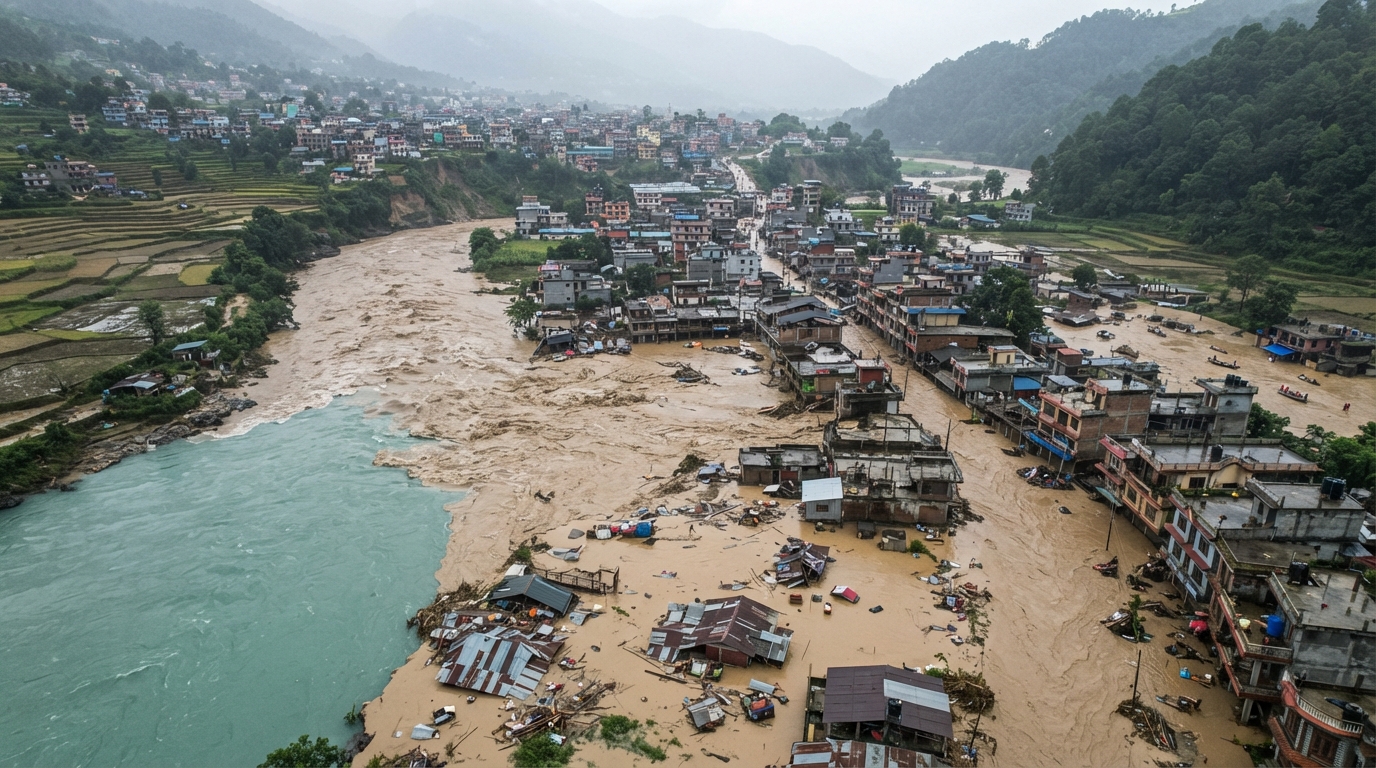
The footage is the kind that doesn’t need commentary to be disturbing: construction workers sprinting ahead of a hundred-foot wall of mud and debris, bridges snapping in half, a border crossing swallowed whole in seconds. What makes it worse is that this isn’t the first time this exact valley has flooded like this — it’s the second time in just over a year.
What Happened
An avalanche of ice and rock from a glacier on the Nepalese side of the border blocked a river and unleashed a sudden surge of water downstream on Wednesday, according to officials and climate experts cited by the Associated Press and reported by Newsweek. The surge tore through Nepal’s Rasuwa district, destroying the villages of Timure, Rasuwagadhi, and Syabrubesi before crossing into Tibet and striking the Chinese border town of Gyirong, according to Portuguese outlet Milenio Stadium.
Death toll figures have climbed sharply as the scale of the disaster became clearer. TMZ, citing early reporting, put the death toll at 31 with many more casualties feared. Milenio Stadium, in more recent reporting roughly eight hours old at time of writing, cited a provisional toll of 160 dead and more than 500 missing, spanning dozens of nationalities. Newsweek reported 384 tourists were among those reported missing, including 291 foreign nationals from countries including India, the United States, the United Kingdom, and Malaysia. Portugal’s Ministry of Foreign Affairs confirmed two Portuguese citizens are among the missing, according to Milenio Stadium, which cited a statement sent to the Lusa news agency.
The flood destroyed at least 80 bridges, roughly 35 for road traffic and 45 suspension bridges, along with around 40 kilometers of roads, hydropower projects, and other infrastructure, severely hampering rescue teams’ access to affected areas, per Milenio Stadium. The U.S. Geological Survey initially recorded the triggering event as a magnitude 4.4 earthquake before reclassifying it as a landslide with a magnitude of 5.2, occurring roughly 55 kilometers northwest of Kodari, according to the same report.
Nepal’s government has declared the affected areas a disaster zone for three months and ordered the mobilization of military and private helicopters for search and rescue operations, per Milenio Stadium. Nepalese government spokesperson Sasmit Pokharel told the AP that Nepal has asked both India and China to help with rescue efforts. Chinese President Xi Jinping requested an “all-out” search for survivors after Chinese state media warned of major casualties at Gyirong port, according to TMZ’s summary of CNN’s reporting. The U.S. Embassy in Nepal said it was “deeply saddened” by the loss of life and urged American citizens to avoid riverbanks and low-lying areas while seeking higher ground.
Newsweek and Yahoo News both noted that Rasuwa district experienced a similar flood in August 2025, when a glacial lake in neighboring Tibet overflowed amid high regional temperatures, killing nine people and damaging a bridge connecting Nepal and China.
A Pattern, Not a One-Off
Two catastrophic glacial-origin floods hitting the same district within thirteen months isn’t a coincidence worth glossing over, it’s a pattern that deserves to be treated as one. Rasuwa sits in exactly the kind of high-altitude terrain where warming temperatures are destabilizing glaciers and the moraine-dammed lakes they feed, and scientists have warned for years that these glacial lake outburst floods, GLOFs, are becoming more frequent and less predictable across the Himalayas as the region warms faster than the global average. A district getting hit twice by the same category of disaster in barely a year is the kind of data point that should move this from a recurring tragedy to a standing engineering and evacuation-planning priority.
What should concern officials most isn’t just the death toll, it’s the number of tourists caught in the disaster zone with seemingly little warning. Nearly 300 foreign nationals reported missing in a single event suggests the existing monitoring and alert systems for this specific valley, one that has now flooded catastrophically twice, aren’t reaching the people passing through it. Search and rescue will dominate the headlines for the next several days, but the harder, less visible question is whether Nepal, China, and the international scientific community treat this as the second warning it clearly is, or wait for a third.