A basketball game stopped mid-quarter Sunday night — not for an injury, not for a replay review, but because a former NBA center in the stands was wearing a shirt with a dictionary definition printed on it, and one of the players on the court decided she’d had enough.
What Happened
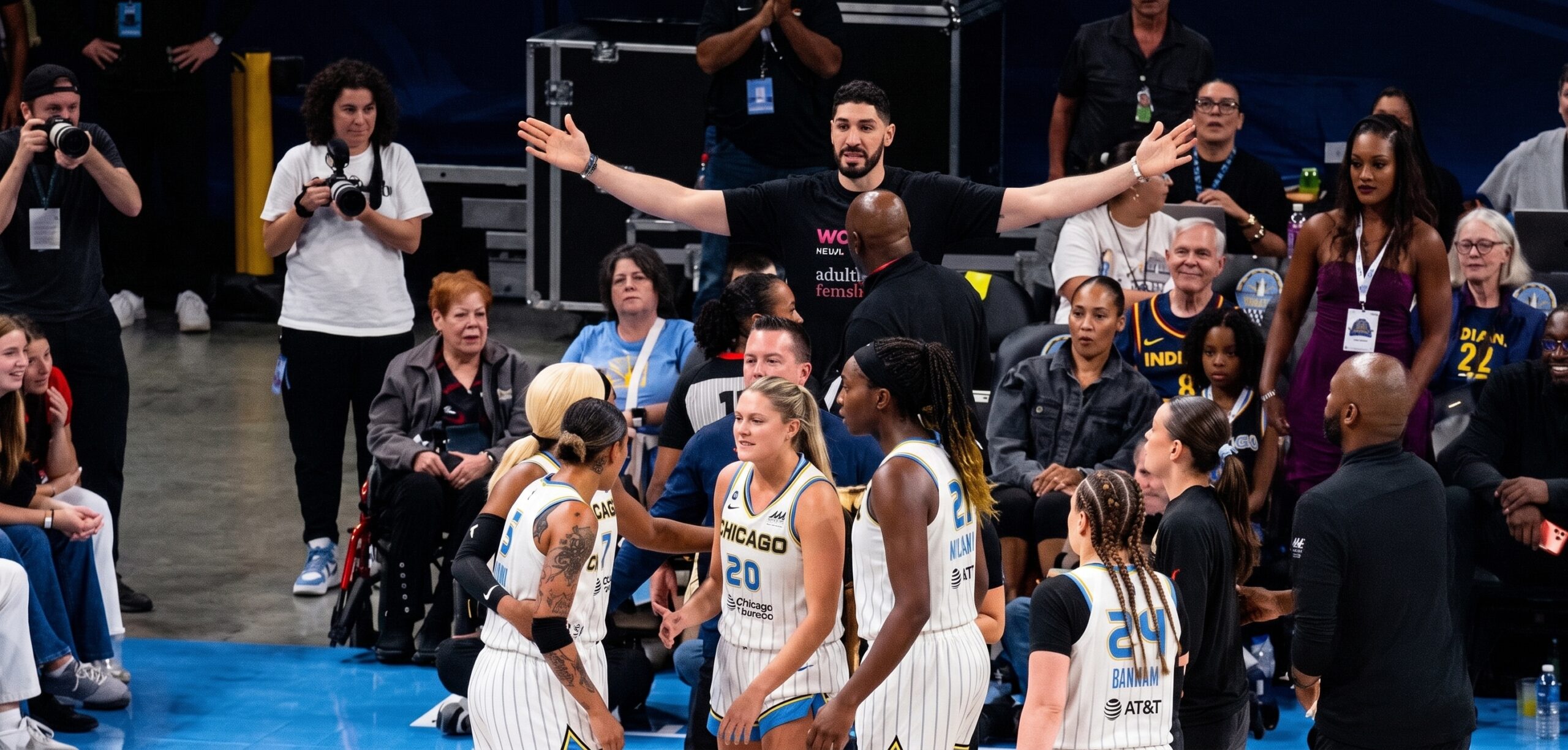
According to CBS News, citing CBS Sports and the Associated Press, former NBA player Enes Kanter Freedom was ejected from Sunday’s Indiana Fever–Chicago Sky game at Wintrust Arena after Sky guard Natasha Cloud confronted him from the court. Kanter Freedom, seated along the baseline, was wearing a black shirt reading “WOMAN noun. adult human female.”
CBS News reported that the Fever called a timeout with 1:22 left in the third quarter, after Cloud scored and chest-bumped a teammate. Cloud then turned and walked toward Kanter Freedom, yelling and pointing at him as she approached. Video cited by CBS News showed Kanter Freedom standing with his arms out and taking a step onto the court before security and several Sky players moved between the two.
Chicago forward Azura Stevens described it afterward as a fan incident that security handled, telling reporters the team was focused on the game, per CBS News. Sky coach Tyler Marsh said Cloud had worried about becoming a distraction for the team, and that he’d told her she wasn’t, adding that teammates stand behind her role in protecting people who need protecting.
Kanter Freedom was escorted from the court area, stopping to plead his case to security and holding his shirt out to the crowd as he was walked toward the arena’s lobby, according to CBS News. He later spoke with police officers before leaving the venue.
Cloud did not speak to media after the game, per CBS Sports, but posted a statement on social media afterward, writing that she considers trans people part of her community and that she will always protect them.
CBS News noted the incident follows recent debate within the WNBA over transgender participation. Fever guard Sophie Cunningham said in an ESPN profile last month that she opposes transgender women competing in women’s sports, and Kanter Freedom joined a rally supporting Cunningham outside the arena before Sunday’s game. Both Kanter Freedom and former NBA player Royce White have separately declared themselves eligible for the WNBA draft, saying they identify as women; the WNBA’s collective bargaining agreement restricts the league to women but does not define gender identity or sex assigned at birth. No transgender player has played in the WNBA to date. CBS News also noted that Cloud and Kanter Freedom have clashed before, dating back to a 2023 social media exchange.
Two People Performing for an Audience That Was Already Decided
Strip away the politics for a moment and look at what actually happened on video: a fan wore a shirt engineered to provoke a reaction, and a professional athlete gave him one, mid-game, in front of a live crowd and cameras. Neither of those choices happened by accident. Kanter Freedom has built a public persona around confrontational statements since his NBA years, and Cloud has been one of the WNBA’s most outspoken players on social issues for nearly as long. This wasn’t two strangers colliding — it was two people who already knew exactly what reaction they’d get from doing what they did, in a league that has spent the last several months turning nearly every off-court incident into content for the broader trans-athletes debate.
That’s arguably the more interesting story than the shirt or the shouting: the WNBA has become a proxy battleground for a national argument it didn’t start and doesn’t have the power to resolve on its own, given that no transgender athlete has actually played in the league. Every incident like Sunday’s gets absorbed into a debate that’s happening mostly in the abstract, driven by declared draft eligibility and rally attendance rather than any player currently on a roster. Whatever one believes about the underlying policy question, it’s worth being honest that this particular flashpoint was symbolic on both sides — a shirt and a confrontation, standing in for an argument that neither side is actually having with each other.