The US government has spent years building a legal wall around Chinese technology companies it suspects of aiding Beijing’s military. That wall now has cracks in it, and China’s largest memory chipmaker just found one big enough to walk through — with a growing list of court rulings suggesting American judges are no longer willing to take the Pentagon’s word for it.
The Lawsuit
ChangXin Memory Technologies (CXMT), China’s largest producer of dynamic random-access memory (DRAM) chips, filed a federal lawsuit on Friday, August 29, in the U.S. District Court for the District of Columbia against the U.S. Department of Defense, according to Bloomberg. The suit names Defense Secretary Pete Hegseth as a defendant and seeks CXMT’s removal from the Pentagon’s Section 1260H list, a roster of Chinese companies the U.S. government designates as having ties to China’s military, per the South China Morning Post.
CXMT’s complaint is direct about what it believes is at stake. “CXMT is not affiliated with the Chinese military,” the company stated in its filing, according to Benzinga, which reported CXMT’s position that it “designs, produces, and sells its DRAM chips for civilian and commercial use, not for military use.” The company’s statement, cited by German outlet heise online via Bloomberg, added that “since its initial designation in January 2025, CXMT has continuously suffered reputational and commercial harm,” and that the lawsuit is intended “to protect its reputation and business interests.”
CXMT argues the Pentagon’s decision was “arbitrary” and lacked sufficient supporting evidence, while also alleging violations of its due-process rights, according to Benzinga. Tom’s Hardware, which reviewed the underlying designation criteria, reported that in June 2026 the Pentagon classified CXMT as “directly affiliated with MIIT and indirectly affiliated with SASAC and MIIT” — a reference to China’s Ministry of Industry and Information Technology and the State-owned Assets Supervision and Administration Commission, the body that formally holds the Chinese government’s ownership stakes in non-financial state enterprises. Tom’s Hardware noted that while CXMT memory chips can certainly be found in systems used by China’s military or intelligence services, that alone does not establish CXMT as a direct supplier to those entities, nor does it prove the company qualifies as a “Chinese military company” under the statute’s intended meaning.
A Withdrawn Notice and a Pattern of Retained Listings
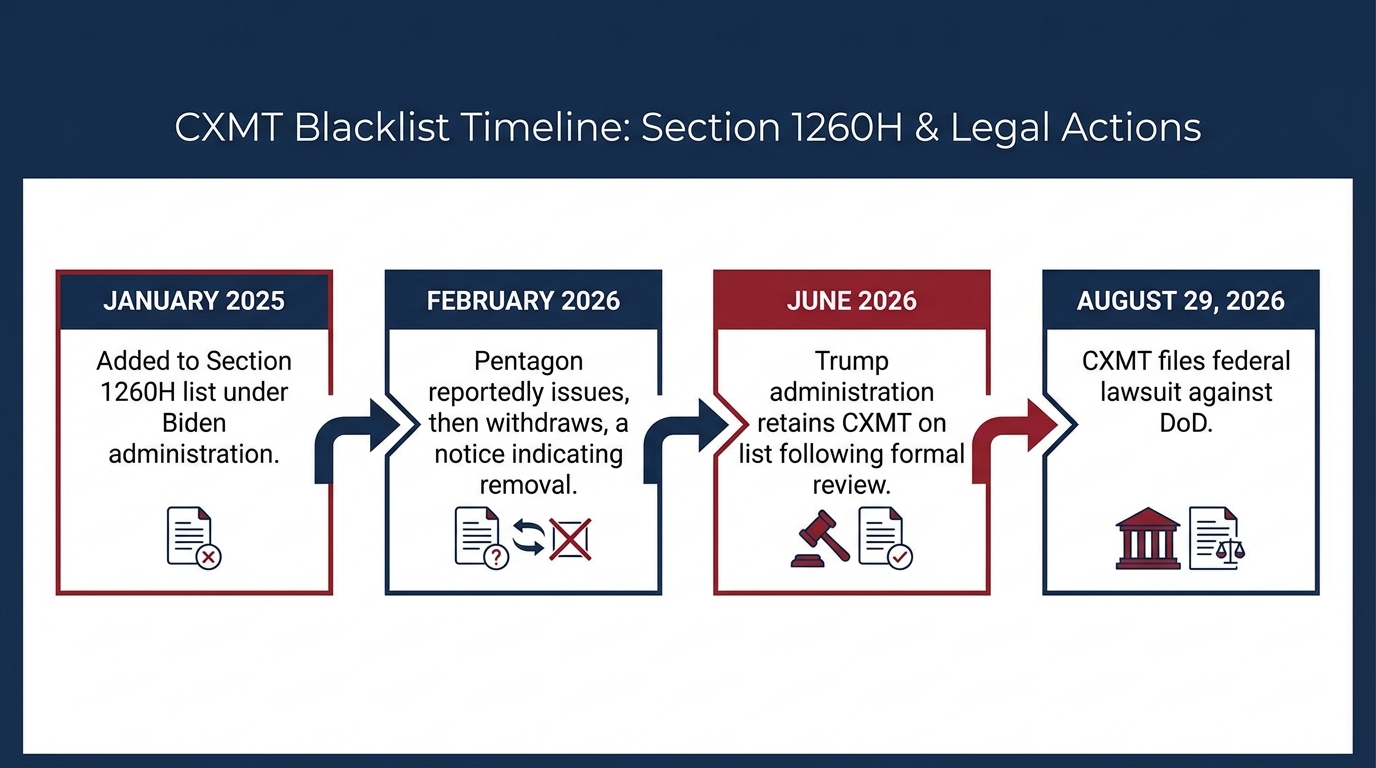
One of the more striking details in CXMT’s case, reported by Tom’s Hardware, is the company’s claim that the Department of Defense published a notice in February 2026 indicating CXMT would be removed from the list, only to withdraw that notice later the same day without explanation. The Pentagon originally designated CXMT under the Biden administration in January 2025, and the Trump administration subsequently retained the company on the list during a formal review completed in June 2026, according to multiple outlets including Benzinga and Techno Time.
The Pentagon has not addressed the specifics of CXMT’s claims publicly. According to Techno Time and MacObserver, the Department of Defense stated that, as a matter of policy, it does not comment on pending litigation.
Part of a Bigger Legal Pattern
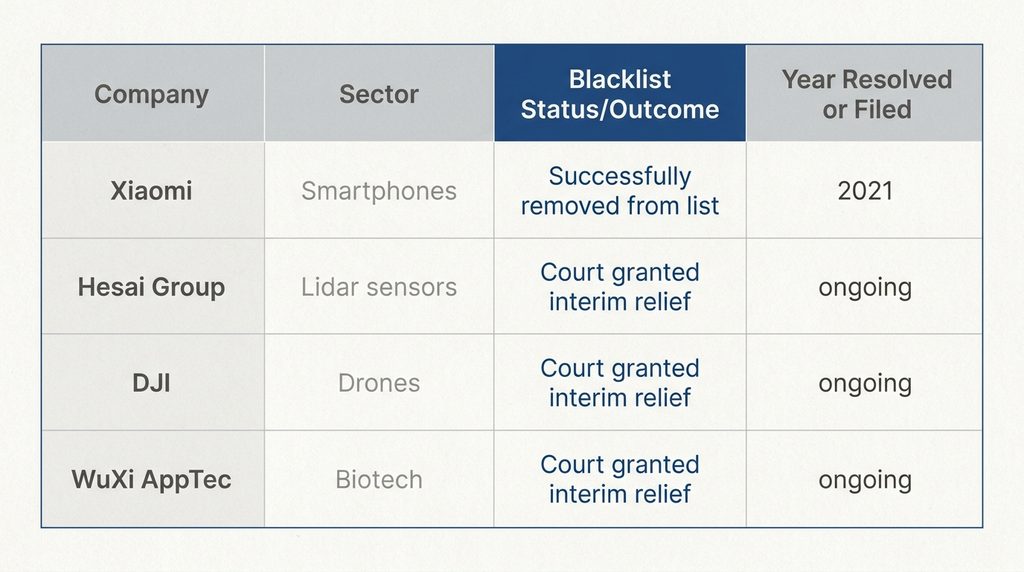
CXMT’s lawsuit is not an isolated case. The South China Morning Post reported that CXMT has joined “a growing list” of Chinese technology companies challenging their Pentagon blacklist designations in U.S. courts, and that legal experts see meaningful momentum building in these companies’ favor. Mark Shi, a compliance lawyer at Shanghai-based Co-Effort Law Firm, told the South China Morning Post that recent rulings involving Chinese firms including lidar sensor maker Hesai Group, drone manufacturer DJI, and biotech company WuXi AppTec show that U.S. judges “had shown a willingness to hold the Department of Defence to account,” scrutinizing the government’s evidence rather than deferring to it automatically, and in some cases granting interim relief while cases proceed.
E-commerce giant Alibaba Group Holding is also currently challenging a separate designation and was granted a temporary reprieve over a lobbying restriction last month, according to the South China Morning Post. (The Post disclosed that Alibaba owns the publication itself, a relevant disclosure given the overlapping subject matter.) Smartphone maker Xiaomi provides a precedent for how these cases can end: Benzinga reported that Xiaomi successfully fought its own military-company designation back in 2021 and eventually secured removal from the list entirely.
Legal observers cited by the South China Morning Post framed the CXMT case as a potential test of a specific legal question with implications well beyond one chipmaker: whether a company’s broad institutional ties to a Chinese government ministry or state-asset regulator are sufficient, on their own, to justify labeling it a military-linked entity — and how much evidentiary weight U.S. courts should give the Pentagon’s internal reasoning when it makes that call.
Why This Case Matters Commercially — Not Just Legally
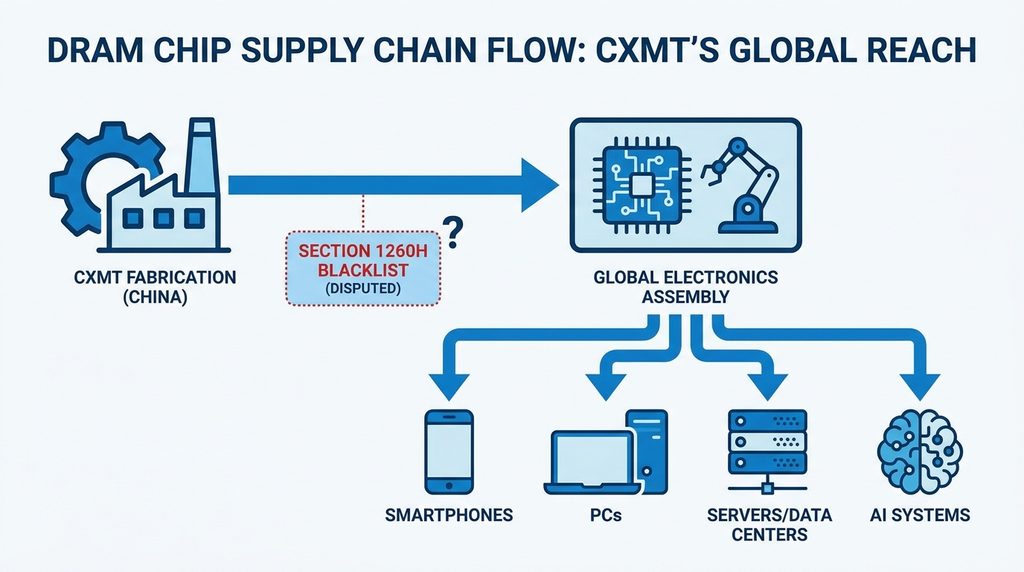
The commercial stakes behind CXMT’s lawsuit are considerable. The company is China’s top DRAM producer, supplying memory chips used across smartphones, PCs, servers, and AI systems, and Benzinga reported its revenue surged 874% in the first half of 2026 alone, a figure that underscores how central CXMT has become to the global memory chip supply chain amid booming AI-related demand.
That commercial momentum is colliding directly with U.S. politics in a very specific, high-profile way. Multiple outlets, including heise online and MacObserver, reported that Apple had reportedly tested CXMT-made RAM for potential use in iPhone models sold in China, and in doing so drew direct political pushback: U.S. senators reportedly pressured Apple to avoid purchasing memory from the blacklisted supplier. heise online noted that while the U.S. government cannot directly sanction Apple over the purchase, since CXMT itself, not Apple, carries the blacklist designation, removing CXMT from the Section 1260H list would meaningfully reduce the political pressure Apple currently faces over the relationship. Separately, Techno Time reported that CXMT is already positioned to power the upcoming Xiaomi 18 Fold with next-generation LPDDR6 DRAM chips, another sign of how deeply embedded the chipmaker has become in consumer electronics supply chains that extend well beyond China’s borders.
CXMT has also sought to reassure its existing customers and partners that the blacklist designation, win or lose in court, is not currently disrupting its core business. According to heise online’s reporting, the company emphasized that the blacklist does not affect its daily operations, even as it argues in its lawsuit that the designation has caused ongoing reputational and commercial harm.
The Legal Ground Is Shifting Under Washington’s Feet
What makes the CXMT case worth watching closely isn’t really about one chipmaker’s reputation, it’s about whether the entire legal architecture the U.S. has built around these military-company blacklists can survive sustained judicial scrutiny. For years, a Section 1260H designation functioned almost like a permanent commercial death sentence: once a company landed on the list, American firms simply stopped doing business with it, regardless of whether the underlying evidence would hold up in open court. Mark Shi’s comment to the South China Morning Post, that judges are now willing to scrutinize the government’s evidence and grant interim relief, suggests that assumption is eroding in real time, one favorable ruling at a time.
The withdrawn February notice is the detail that should worry Pentagon lawyers most. A government agency that appears to have decided internally that a company qualified for removal, then reversed course within the same day without public explanation, hands CXMT’s attorneys exactly the kind of process-based ammunition courts tend to find persuasive, regardless of how the underlying national-security merits eventually shake out. Whether or not CXMT actually has ties to China’s military is, in a strange way, becoming secondary to a more fundamental question the courts now seem willing to ask: did the Pentagon follow a defensible, evidence-based process in deciding that it does? If CXMT wins, expect the current wave of Chinese tech companies challenging their designations to turn into a flood, and expect the Pentagon’s blacklist to face a credibility problem it cannot simply litigate its way out of.